Executive Summary: Key Technical Insights
- Classification surveys verify a vessel's structural integrity, machinery condition, and safety equipment against published technical rules. Statutory certification confirms that the vessel meets national regulatory requirements for safe operation in designated waters.
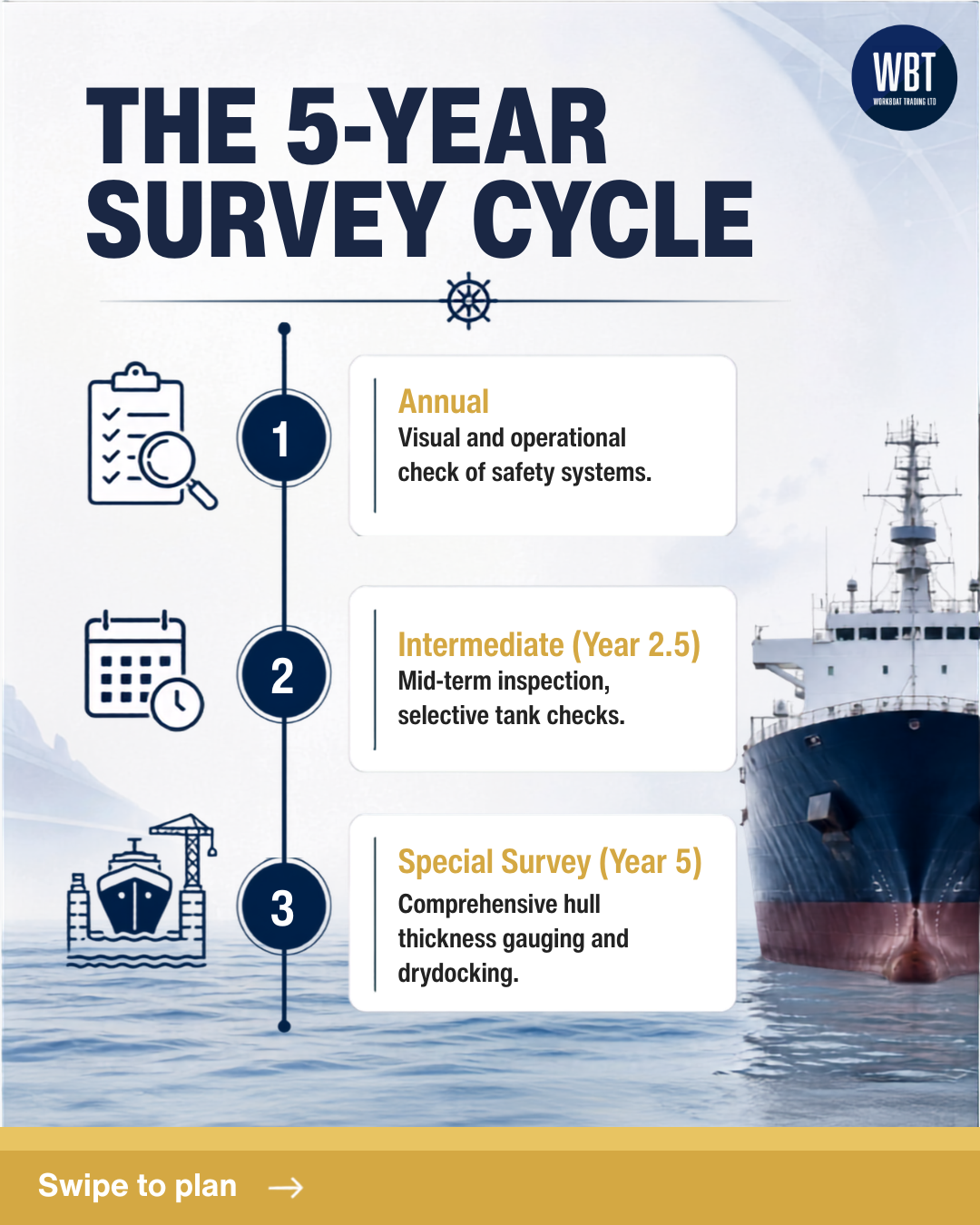
- The standard classification cycle for commercial vessels operates on a five-year period, with annual surveys, an intermediate survey (typically at the 2.5-year mark), and a special survey (class renewal) at the five-year mark.
- Annual surveys are primarily visual inspections of hull structure, safety systems, and machinery. Special surveys are comprehensive examinations that may require drydocking, ultrasonic thickness measurement of hull plating, and detailed machinery overhaul.
- In Singapore, MPA administers statutory certification for harbour craft under the Merchant Shipping Act and associated regulations. Harbour craft must carry valid certificates including the Harbour Craft Licence, Safety Equipment Certificate, and applicable manning certificates.
- For buyers evaluating vessels on the WBT Singapore marketplace, understanding the survey status, class conditions, and certificate validity of a vessel is critical to accurate valuation and avoiding post-purchase compliance costs.
What Is Vessel Classification?
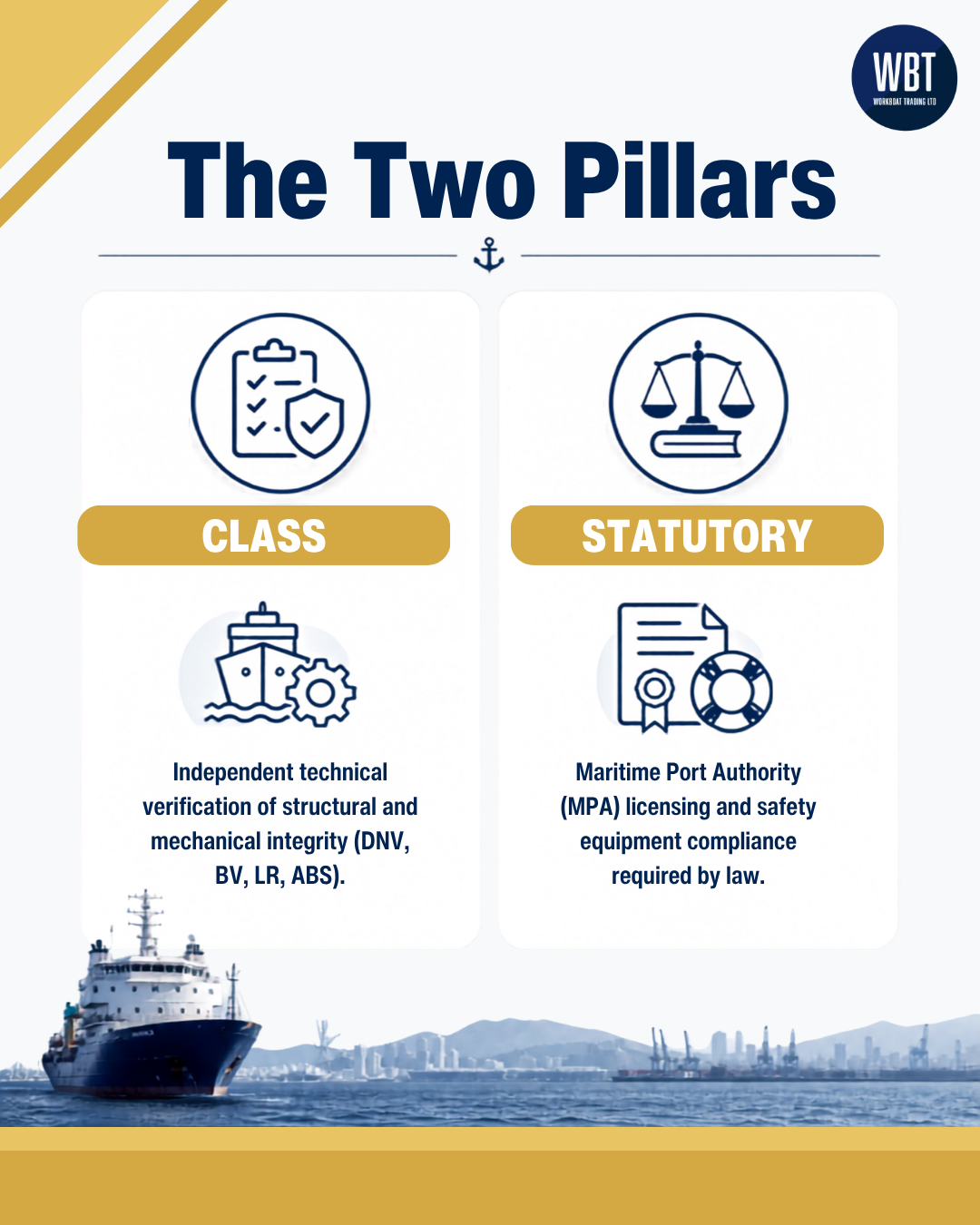
Classification is a system of independent technical verification originally developed to protect the interests of marine insurers. A classification society — such as Lloyd's Register, Bureau Veritas, DNV, ABS, ClassNK, or the China Classification Society — publishes a set of structural, mechanical, and electrical rules. A vessel designed, built, and maintained in accordance with those rules is said to be "in class."
Being in class is not a legal requirement in all jurisdictions, but it is a practical commercial necessity. Marine insurers, charterers, port authorities, and buyers all rely on classification status as an independent verification of a vessel's technical condition. A vessel that drops out of class — whether through expired surveys, unresolved conditions of class, or failure to comply with classification society rules — will face severely restricted commercial options and significant valuation impairment.
For harbour craft in Singapore, MPA recognises several classification societies as authorised bodies. Vessels classed with a recognised society benefit from streamlined statutory certification processes, as MPA may accept classification survey reports in lieu of separate statutory inspections for certain technical areas.
The Five-Year Classification Cycle
Initial Classification Survey
When a new vessel is built or an existing unclassed vessel enters classification for the first time, a classification surveyor conducts a comprehensive examination covering hull structure, propulsion and auxiliary machinery, electrical systems, steering gear, fire protection, and safety equipment. The surveyor verifies that the vessel has been designed and constructed in accordance with the society's rules and issues the initial classification certificate.
For newbuilds, the classification process begins during construction. The classification society reviews hull structural plans, machinery arrangement drawings, and safety system designs before approving fabrication. Surveyors attend the shipyard at key milestones — keel laying, hull completion, machinery installation, sea trials — to verify that construction matches approved plans.
Annual Survey
Annual surveys are conducted within a window around each anniversary of the classification certificate (typically within three months before or after the anniversary date). The annual survey is primarily a visual and operational examination. The surveyor inspects accessible hull structure, verifies that safety equipment is present and functional, checks machinery for obvious defects or deterioration, and reviews the vessel's maintenance records.
Annual surveys do not normally require drydocking. However, the surveyor may recommend additional examination if they observe deterioration that warrants closer inspection. Missing an annual survey window can result in suspension of class, which has immediate commercial and insurance consequences.
Intermediate Survey
The intermediate survey is a more detailed examination conducted at or around the 2.5-year mark of the five-year cycle. Depending on the vessel's age, type, and classification society rules, the intermediate survey may include internal examination of selected ballast tanks, assessment of coating condition, operational testing of critical machinery systems, and review of the vessel's planned maintenance records.
For older vessels, the intermediate survey scope increases. Classification societies may require thickness gauging of suspect hull areas, underwater inspection in lieu of drydocking (UWILD), or enhanced machinery examination. The intermediate survey serves as a mid-cycle checkpoint to identify emerging structural or mechanical issues before they escalate to the special survey.
Special Survey (Class Renewal)
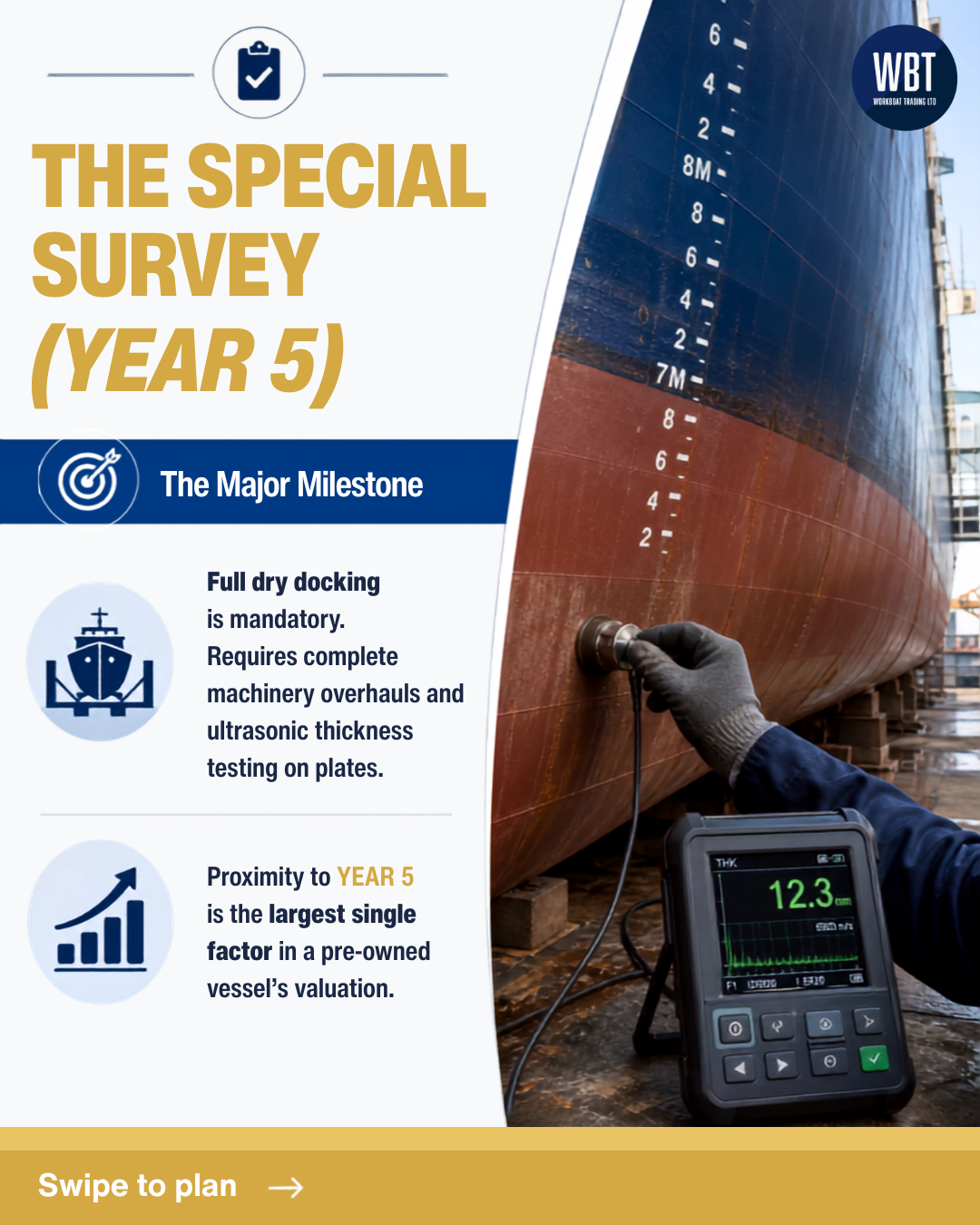
The special survey is the most comprehensive examination in the classification cycle and coincides with the five-year renewal of the classification certificate. A special survey typically requires:
- Full drydocking for hull inspection, propeller and rudder examination, and sea chest verification
- Ultrasonic thickness measurement of hull plating, particularly in ballast tanks, void spaces, and areas of known corrosion risk
- Detailed examination and operational testing of main engines, generators, steering gear, and critical auxiliary systems
- Verification of fire protection, lifesaving appliances, navigation equipment, and communication systems
- Review of all outstanding recommendations and conditions of class
The special survey is the most expensive scheduled maintenance event in the vessel's operating cycle. For buyers considering a pre-owned workboat, the proximity to the next special survey is a critical valuation factor. A vessel approaching its special survey will carry the cost of drydocking and potential steel renewal as a discount against its market price. To browse vessels and assess their survey status, the WBT Singapore platform provides listing details including class and certification information.
MPA Statutory Certification for Singapore Harbour Craft
Harbour Craft Licence
All harbour craft operating in Singapore port waters must hold a valid Harbour Craft Licence issued by MPA. The licence specifies the vessel's permitted operational area, maximum crew and passenger capacity, and any operational restrictions. Licence renewal requires the vessel to be in satisfactory condition and in compliance with applicable safety standards.
Safety Equipment Certificate
MPA requires harbour craft to carry safety equipment appropriate to their operational category. This includes lifesaving appliances (life jackets, lifebuoys, life rafts where applicable), fire-fighting equipment (portable extinguishers, fixed fire suppression systems where required), navigation lights and shapes, sound signalling equipment, and communication systems. The Safety Equipment Certificate confirms that the vessel's safety outfit has been inspected and found compliant.
Manning Certificates
Every harbour craft must be manned in accordance with MPA's minimum manning requirements. The master and crew must hold valid Certificates of Competency (CoC) appropriate to the vessel's tonnage and operational area. Manning certificates verify that the vessel's crew complement meets regulatory minimums for safe navigation and emergency response.
Relationship Between Class and Statutory Surveys
For classed harbour craft, MPA may harmonise statutory inspection requirements with classification survey schedules. This means that a classification surveyor's report on hull condition, machinery status, and safety equipment may satisfy certain MPA statutory requirements without requiring a separate government inspection. This harmonisation reduces survey burden and cost for vessel operators, provided the vessel maintains continuous class with a recognised society.
However, harmonisation does not eliminate all statutory obligations. MPA retains independent authority to inspect any harbour craft at any time, and certain regulatory requirements — such as manning compliance, pollution prevention, and operational safety — remain outside the scope of classification.
Conditions of Class and Recommendations
What Are Conditions of Class?
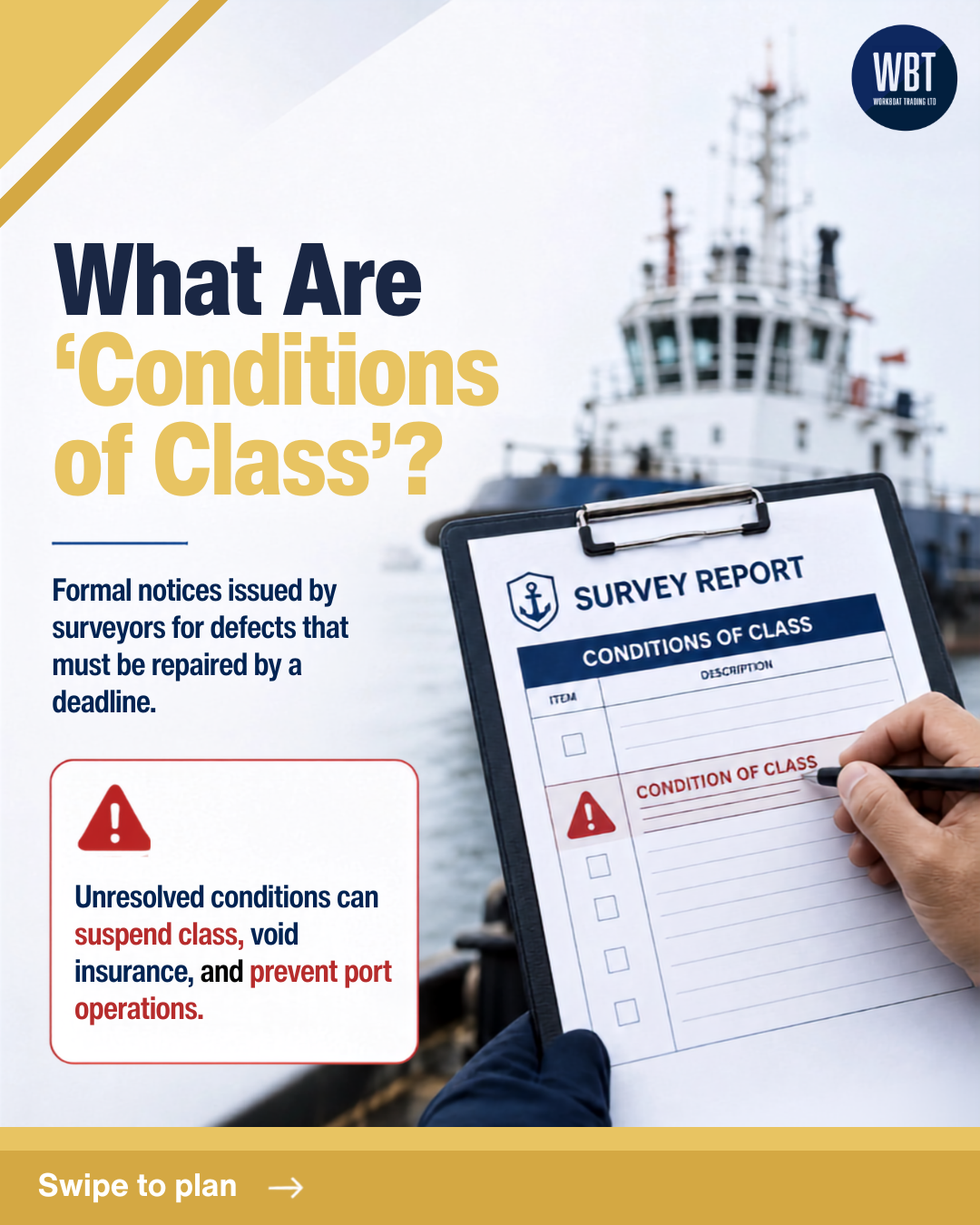
During any survey, a classification surveyor may identify defects, damage, or non-compliance items that require rectification within a specified timeframe. These are recorded as "conditions of class." A vessel with outstanding conditions of class remains technically in class, but the conditions must be resolved by the stated deadline. Failure to comply results in suspension or withdrawal of class.
Impact on Vessel Transactions
For buyers and sellers on the WBT Singapore marketplace, conditions of class are a critical due diligence item. A vessel with unresolved conditions may require expensive remedial work — such as steel renewal, machinery overhaul, or safety system replacement — that directly affects its fair market value. Buyers should request a current class status report and verify that no outstanding conditions exist before completing a purchase.
Similarly, sellers listing vessels on WBT Singapore should ensure that class conditions are either resolved or transparently disclosed, as undisclosed conditions can create significant post-transaction disputes and erode buyer confidence in the platform.
Survey Planning and Cost Management
Proactive Maintenance Reduces Survey Risk
Vessel operators who maintain rigorous planned maintenance systems — including regular hull coating inspections, anode replacements, engine servicing, and safety equipment checks — significantly reduce the risk of unexpected findings during classification surveys. Proactive maintenance also extends the intervals between drydocking, reduces steelwork renewal at special survey, and supports stronger insurance and charter negotiations.
For workboats operating in Singapore's tropical waters, this includes disciplined management of corrosion protection, cooling system maintenance, and propulsion system servicing — all areas that tropical conditions stress more heavily than temperate environments.
Budgeting for Special Surveys
Fleet managers should budget for special surveys as a percentage of annual vessel operating costs. As a general planning benchmark, a special survey with drydocking for a harbour craft in the 15–30 metre range may cost between SGD 80,000 and SGD 250,000, depending on the extent of steel renewal, machinery overhaul, and coating work required. Vessels that have been well-maintained will sit at the lower end of this range; those with deferred maintenance will face significantly higher costs.
Continuous Survey Machinery (CSM) Programmes
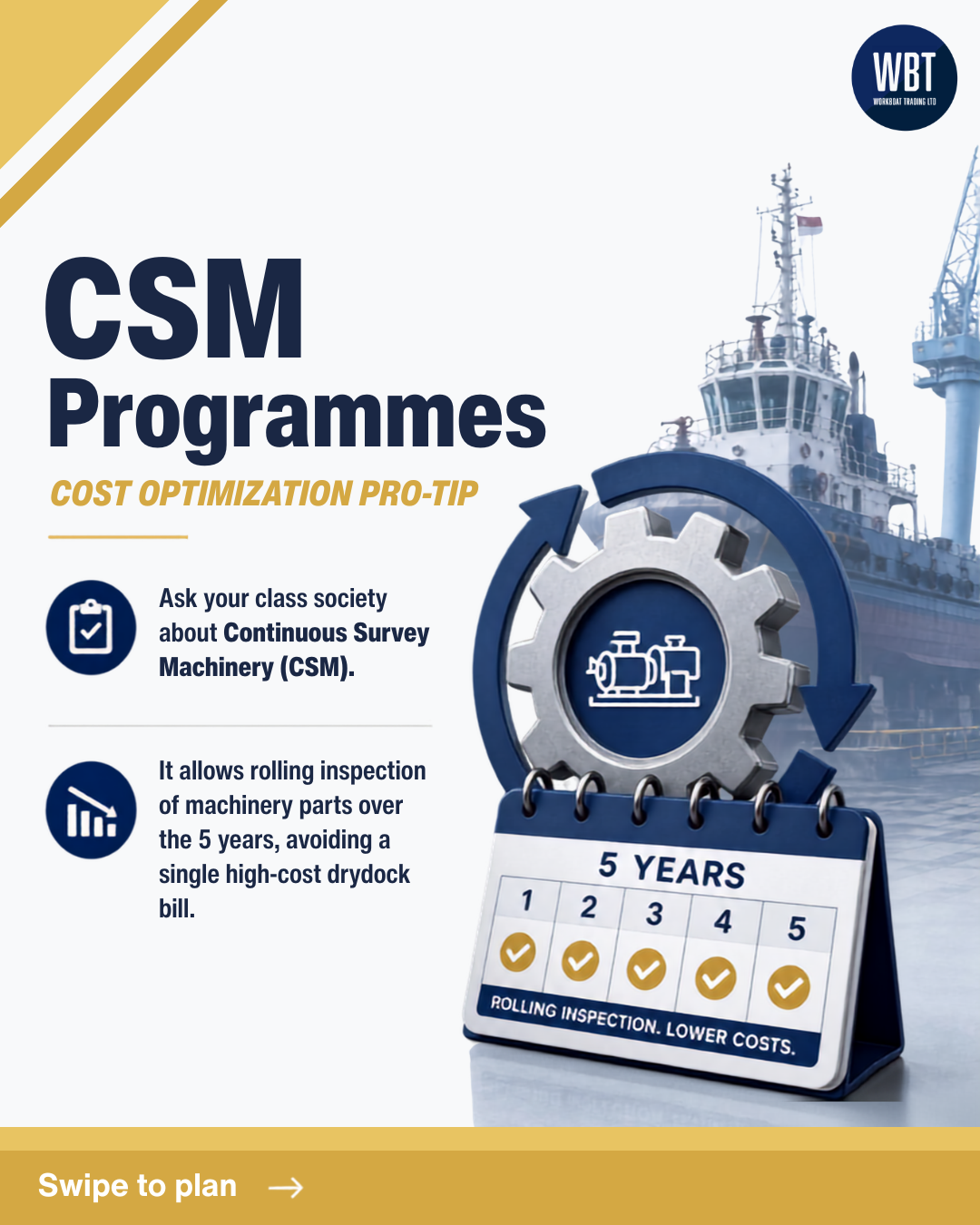
Some classification societies offer Continuous Survey Machinery (CSM) programmes, which allow machinery components to be surveyed individually on a rolling basis rather than all at once during the special survey. CSM programmes spread machinery survey costs and downtime across the five-year cycle, reducing the financial impact of the special survey year. Operators considering CSM should discuss eligibility and scheduling with their classification society surveyor.
FAQ
What is the difference between classification and statutory certification?
Classification is an independent technical verification conducted by a classification society against its own published rules. Statutory certification is a government regulatory requirement administered by national maritime authorities such as Singapore's MPA. Both are typically required for commercial harbour craft operations.
How often do commercial workboats need classification surveys?
The standard classification cycle includes annual surveys, an intermediate survey around the 2.5-year mark, and a comprehensive special survey (class renewal) every five years. Missing survey deadlines can result in suspension of class.
What happens if a vessel loses its classification?
A vessel that loses class — through expired surveys, unresolved conditions, or non-compliance — faces severely restricted commercial options. Marine insurers may withdraw cover, charterers may refuse to engage, and the vessel's market value will decline significantly. Restoring class typically requires a full special survey, which can be costly.
How does survey status affect vessel resale value?
Survey status is one of the most important valuation factors for pre-owned commercial vessels. A vessel freshly through its special survey with clean class and valid certificates commands a premium. A vessel approaching its special survey trades at a discount reflecting the anticipated drydocking and remedial work costs. Browse vessels on WBT Singapore to compare listings with their survey and certification details.
Does MPA accept classification surveys in place of statutory inspections?
MPA may harmonise certain statutory inspection requirements with classification survey reports from recognised societies, reducing duplication. However, MPA retains independent authority over manning, pollution prevention, and operational safety inspections regardless of classification status.