Executive Summary: Key Technical Insights
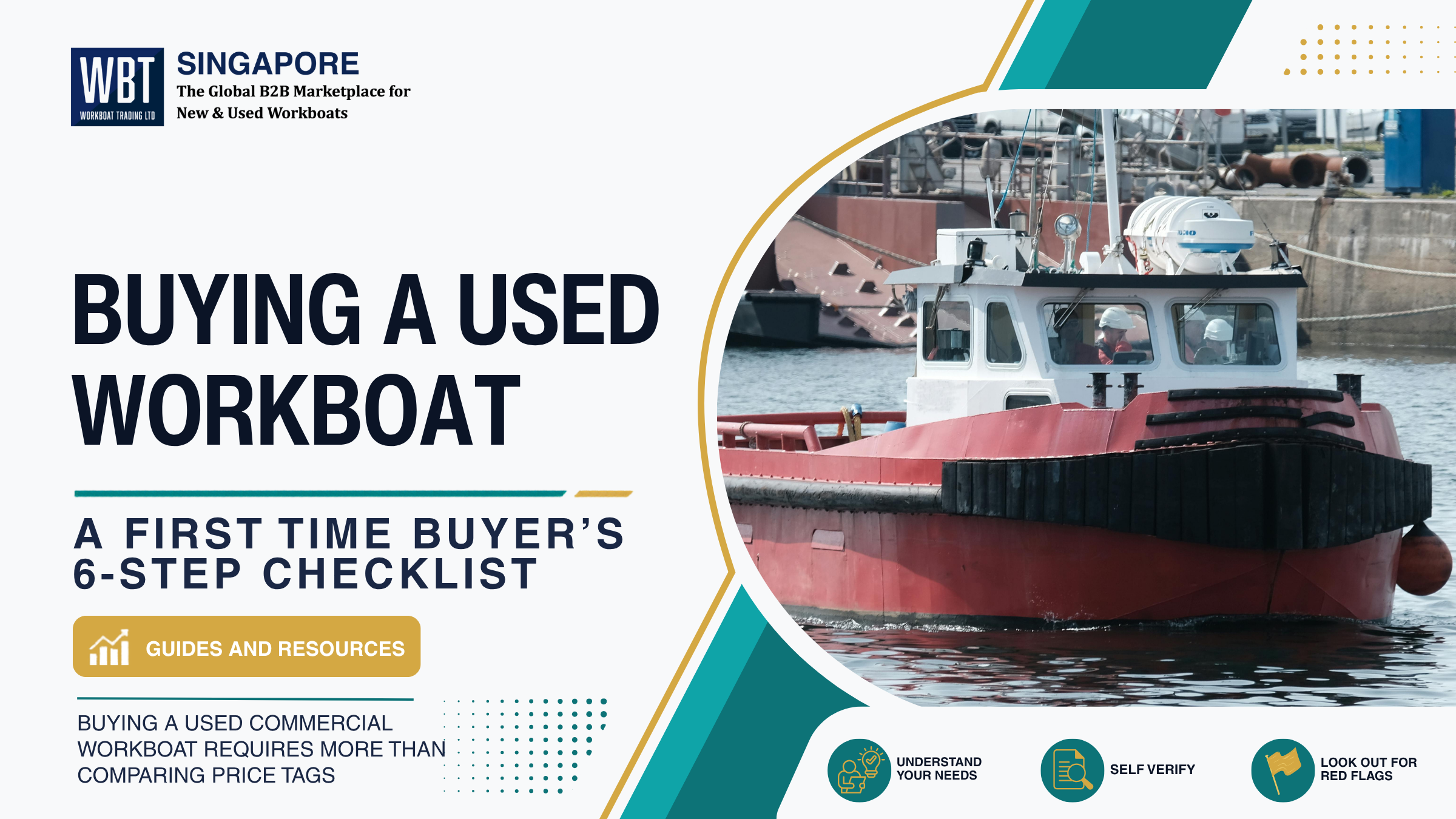
- Buying a used commercial workboat requires evaluating five critical areas: vessel specifications (LOA, beam, draft, gross tonnage, engine hours), classification and regulatory status, independent marine survey results, propulsion system condition, and hull structural integrity.
- Engine hours are the marine equivalent of odometer mileage - they indicate wear and remaining service life, but must be cross-referenced with maintenance records and oil analysis to assess true engine condition.
- A vessel's classification status (whether it is "in class" with a society such as Lloyd's Register, Bureau Veritas, or DNV) is one of the most important factors in any purchase decision; reinstating lapsed class can cost 30–50% of the purchase price.
- An independent marine survey - covering condition, valuation, or both - is strongly recommended before any commercial vessel acquisition to identify hidden defects and establish fair market value.
- Key red flags include incomplete maintenance records, fresh engine-room paint concealing leaks, withdrawn classification, non-standard structural modifications, and seller reluctance to permit independent inspection.
- For vessels operating in Singapore, buyers must verify compliance with the MPA 2030 harbour craft mandate requiring electric, B100 biofuel, or net-zero fuel capability.
Why Buying a Used Workboat Requires a Systematic Approach
Purchasing a used commercial workboat is fundamentally different from buying recreational marine craft. Workboats operate under demanding commercial duty cycles, accumulate high engine hours, and must comply with classification society and flag-state regulations. A vessel that looks sound on the surface may conceal structural fatigue, deferred maintenance, or regulatory non-compliance that can cost more to rectify than the purchase price itself.
Whether you are acquiring your first tug boat, a patrol vessel for a security contract, or a general workboat for offshore support, this checklist provides a structured framework for evaluating any used commercial vessel. If you are still deciding which type of vessel suits your operation, start with our guide on types of workboats explained.
Step 1: Understand the Key Vessel Specifications
Before viewing any listing, you need to understand what the core specifications actually mean and why they matter.
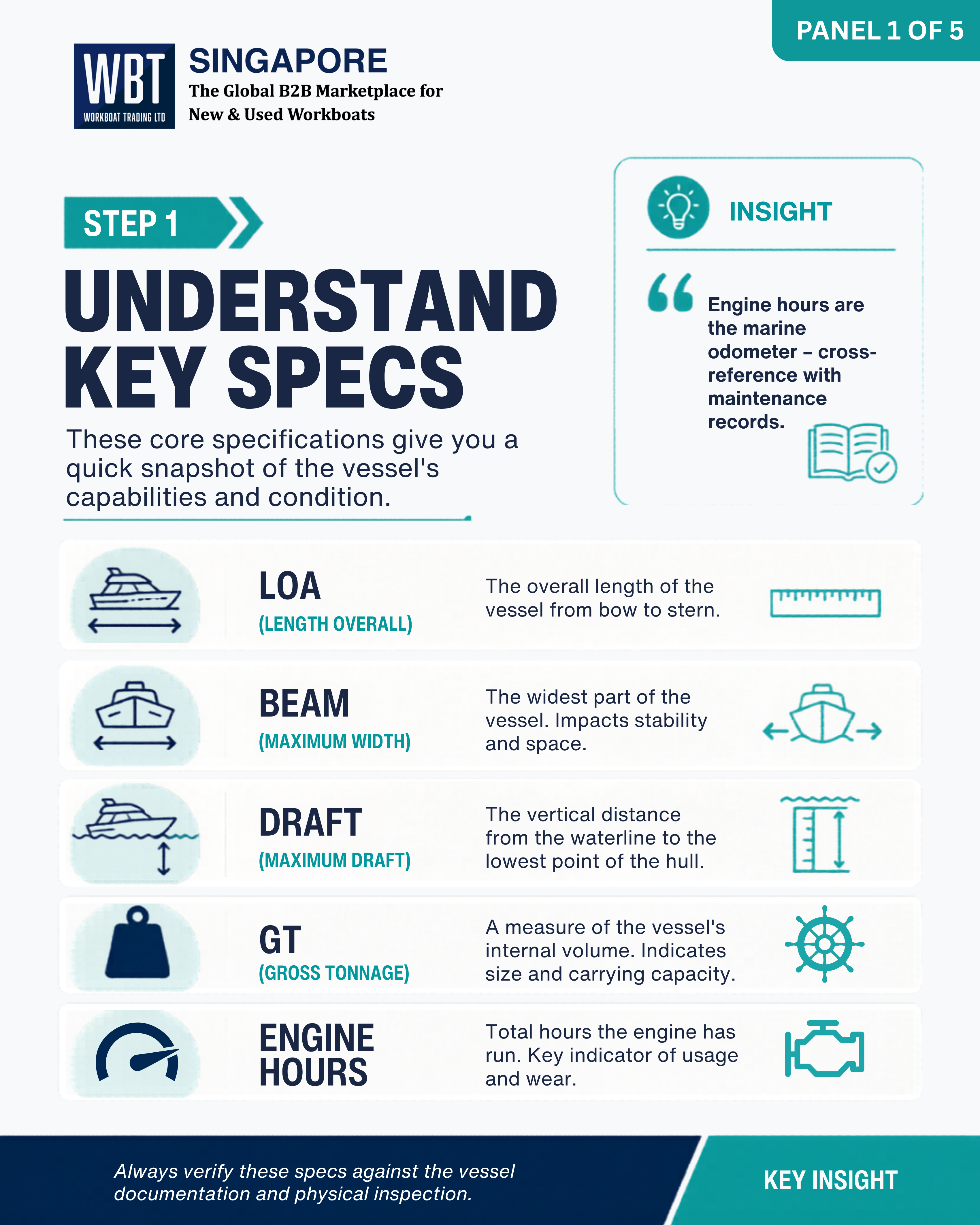
- LOA (Length Overall): The total length of the vessel from bow to stern. LOA determines berthing requirements, port dues, and regulatory classification thresholds.
- Beam: The widest point of the hull. A wider beam generally improves stability but increases drag and port charges.
- Draft: The depth of the hull below the waterline when loaded. Draft determines where the vessel can operate shallow-draft vessels access rivers and coastal areas that deep-draft vessels cannot.
- Gross Tonnage (GT): A measure of the vessel's total internal volume, not weight. GT is used by maritime authorities to determine registration fees, crew certification requirements, and safety equipment mandates.
- Displacement: The actual weight of the vessel when loaded, measured in tonnes. Displacement affects fuel consumption, speed, and structural loading.
- Engine Hours: The total operating hours recorded on the main engines. Engine hours are the marine equivalent of odometer mileage - they indicate wear, remaining service life, and upcoming overhaul intervals.
- Bollard Pull: The static pulling force a vessel can generate, critical for tug boats and any vessel involved in towing operations.
When browsing workboat listings on WBT, these specifications are displayed on every vessel detail page so you can compare like-for-like before making enquiries.
Step 2: Verify Classification and Regulatory Status
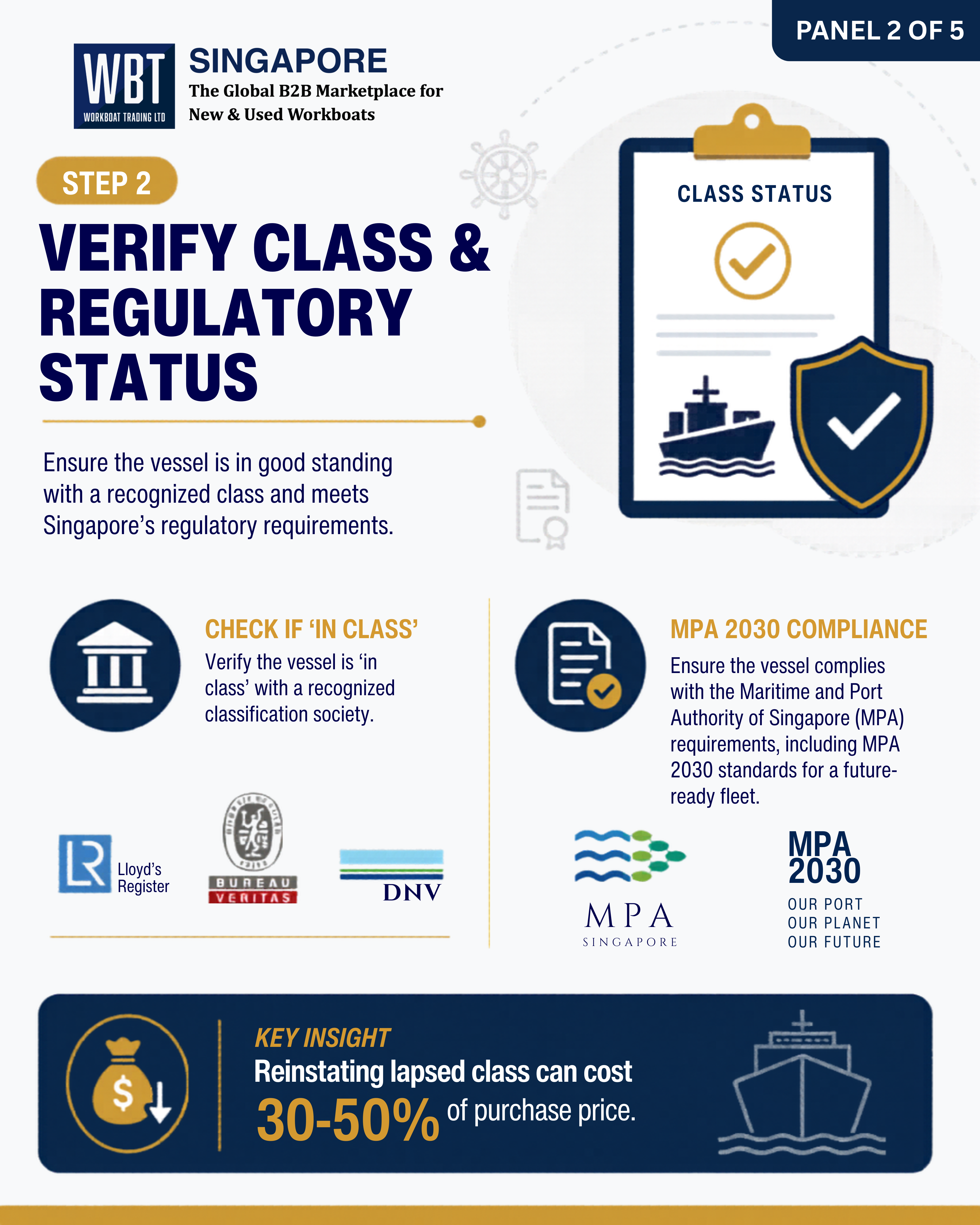
A used workboat's classification status is one of the most important factors in any purchase decision. Classification societies (such as Lloyd's Register, Bureau Veritas, DNV, or ClassNK) inspect vessels against published rules covering hull structure, machinery, electrical systems, and safety equipment.
What to check:
- Class status: Is the vessel "in class" (meaning surveys are current) or has class been suspended or withdrawn? A vessel out of class may require expensive reinstatement surveys.
- Survey history: Request the full survey status report from the classification society. Look for outstanding conditions of class, recommendations, and memoranda.
- Flag-state compliance: Confirm that the vessel's registration, safety certificates, and crew documents are valid for the intended operating area.
- MPA compliance (Singapore): If operating in Singapore waters, verify compliance with the MPA 2030 harbour craft mandate, which requires new harbour craft to use electric, biofuel, or net-zero fuel systems.
> A vessel sold "as is, where is" without current class may seem like a bargain, but reinstatement costs - including dry-docking, steel renewal, and system testing - can easily exceed 30–50% of the purchase price.
Step 3: Commission an Independent Marine Survey
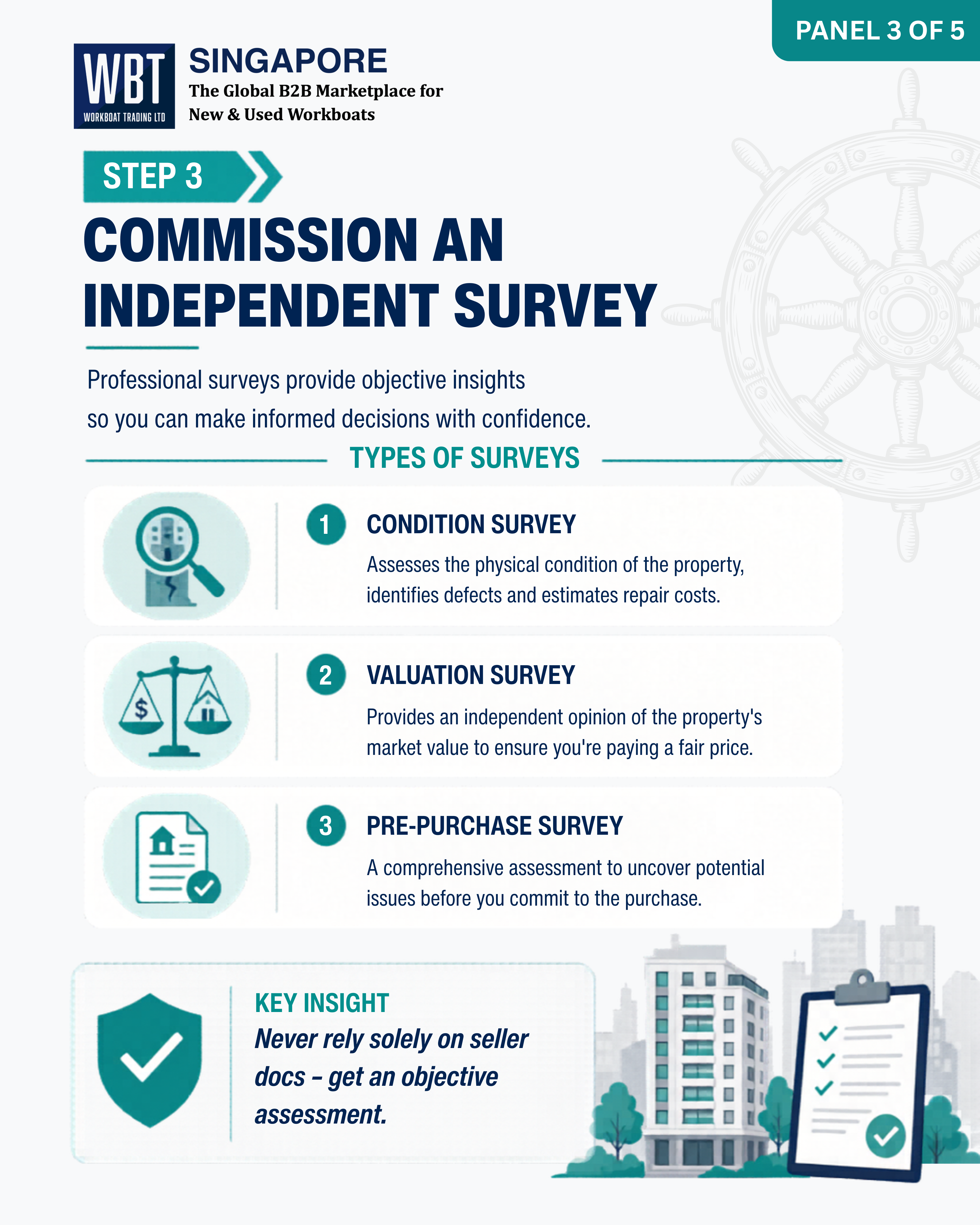
Never rely solely on the seller's documentation. An independent marine survey conducted by a qualified surveyor provides an objective assessment of the vessel's condition.
Types of survey to consider:
- Condition survey: Assesses hull integrity, machinery condition, electrical systems, safety equipment, and general maintenance standard.
- Valuation survey: Establishes fair market value based on vessel age, condition, specifications, and comparable sales.
- Pre-purchase survey: A combined condition and valuation assessment specifically for acquisition decisions.
WBT offers survey coordination services to connect buyers with vetted marine surveyors across key APAC ports. You deal directly with the surveyor to ensure their scope meets your professional standards.
Step 4: Inspect the Propulsion System
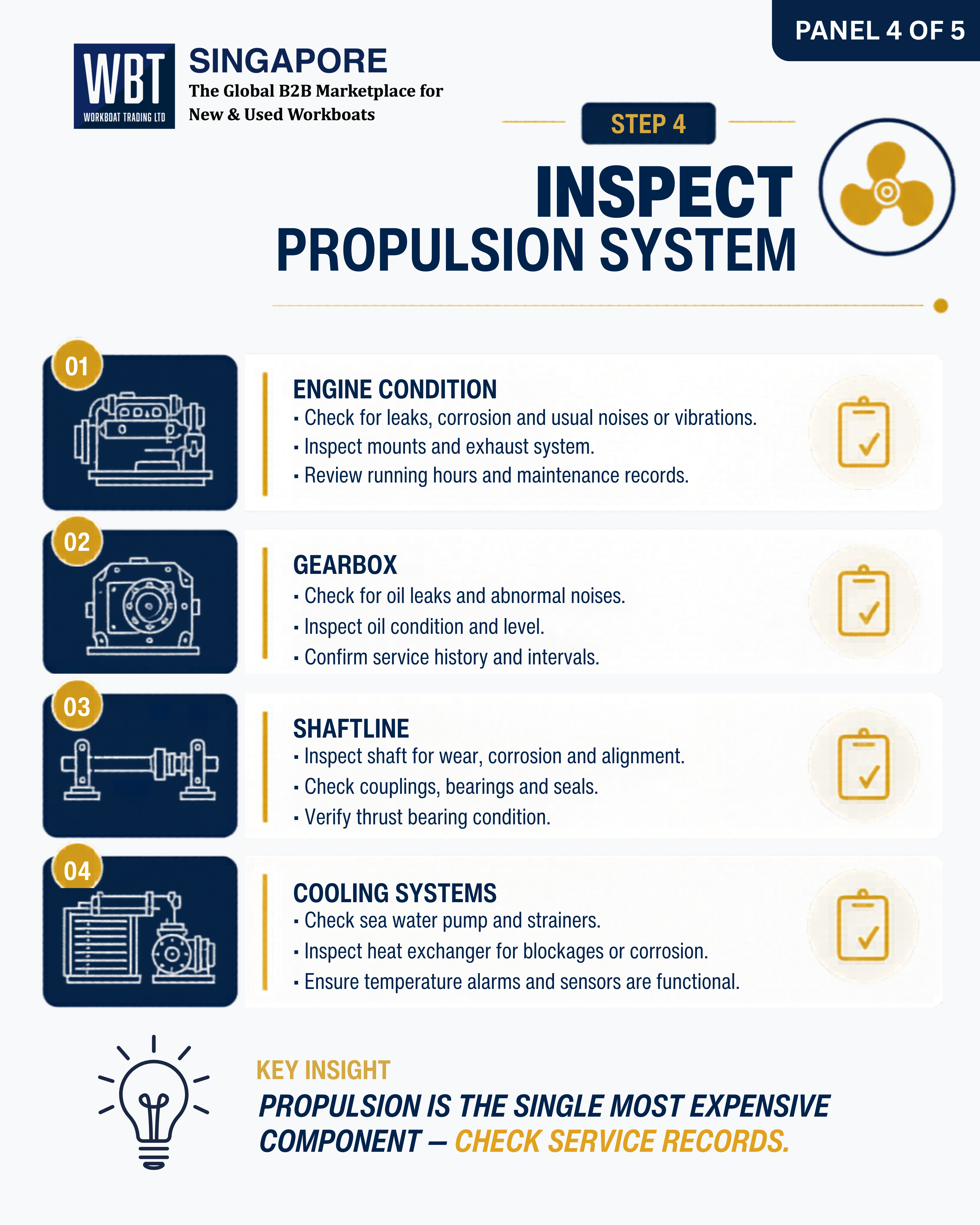
The propulsion system is typically the single most expensive component on a workboat. A thorough assessment should cover:
- Engine condition: Check service records, oil analysis reports, compression test results, and turbocharger condition. Look for evidence of overheating, water ingestion, or deferred maintenance.
- Gearbox and shaftline: Inspect for bearing wear, alignment records, seal condition, and vibration history.
- Propeller and steering: Assess propeller blade condition, pitch settings, rudder play, and steering hydraulic systems.
- Cooling system: In tropical operating environments like Singapore, cooling system integrity is critical. High-salinity seawater accelerates corrosion, scale build-up, and anode degradation. Our technical guide on inboard vs outboard motors for workboats in tropical conditions covers this in detail.
For vessels with high engine hours, request a copy of the manufacturer's recommended overhaul schedule and compare it against the actual maintenance history.
Step 5: Evaluate Hull and Structural Integrity
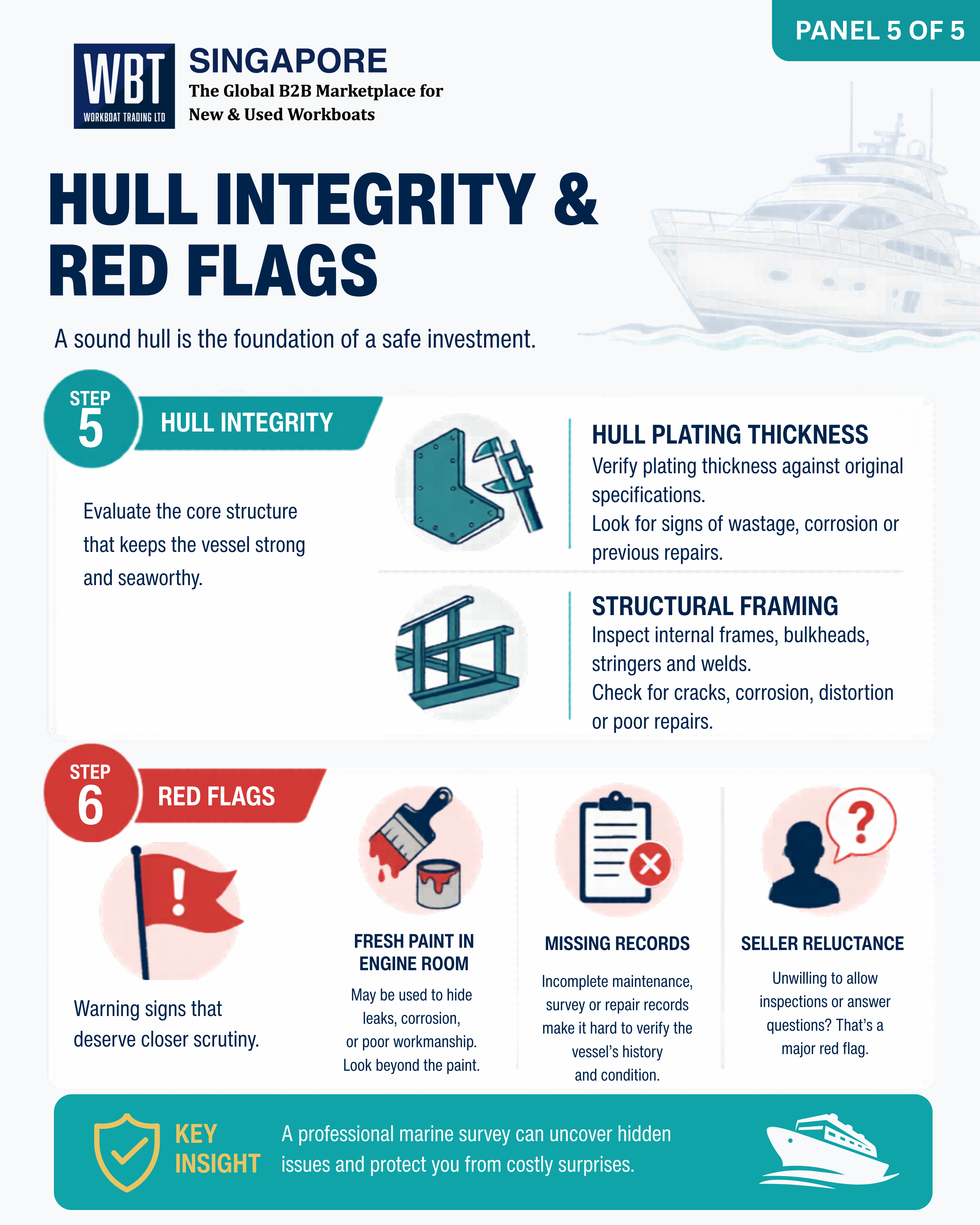
Hull condition determines the vessel's remaining service life and seaworthiness. Key inspection points include:
- Hull plating thickness: Ultrasonic thickness measurements reveal steel wastage from corrosion. Compare readings against the classification society's minimum allowable thicknesses.
- Structural framing: Check for cracking, deformation, or buckling at high-stress points - particularly around the engine mounts, deck openings, towing bollards, and transom.
- Anti-fouling and coatings: Assess the condition of the hull coating system. Deteriorated anti-fouling increases drag, fuel consumption, and maintenance frequency.
- Deck and superstructure: Inspect for water ingress, corrosion around windows and hatches, and deterioration of deck fittings.
Step 6: Identify Red Flags
Experienced buyers watch for warning signs that may indicate hidden problems:
- Incomplete or missing maintenance records: suggests deferred maintenance or ownership changes without proper documentation handover.
- Fresh paint in the engine room: may be cosmetic concealment of oil leaks, corrosion, or structural repairs.
- Class withdrawn or suspended: indicates the vessel failed to meet classification standards and may require major remediation.
- Unusual modifications: non-standard structural changes or equipment installations may compromise the vessel's structural integrity or class status.
- Reluctance to allow independent survey: a seller who resists independent inspection is a significant risk indicator.
Next Steps: Making Your First Enquiry
Once you have identified a vessel that meets your operational, regulatory, and budget requirements, the WBT marketplace allows you to contact sellers directly through secure messaging. For answers to common questions about the buying process, visit our FAQ page or review how the WBT platform works.
FAQ
What should I look for when buying a used workboat?
Focus on five areas: vessel specifications (LOA, beam, draft, GT, engine hours), classification and regulatory status, independent marine survey results, propulsion system condition, and hull structural integrity. Each area can reveal problems that significantly affect the vessel's value and operability.
How important are engine hours on a workboat?
Engine hours are a critical indicator of wear and remaining service life. High engine hours are not inherently negative — a well-maintained engine with 15,000 hours may be in better condition than a neglected engine with 5,000 hours. Always cross-reference engine hours with maintenance records and oil analysis.
Do I need a marine survey before buying a workboat?
Yes. An independent marine survey is strongly recommended for any commercial vessel purchase. It provides an objective condition assessment, identifies hidden defects, and establishes fair market value — protecting your investment from costly surprises.
What does it mean if a vessel is "out of class"?
A vessel out of class has not completed the required surveys to maintain its classification status. Reinstating class can be expensive, requiring dry-docking, structural repairs, machinery testing, and safety equipment upgrades. Factor reinstatement costs into your purchase budget.
Where can I buy a used workboat?
WBT (Workboat Trading) is a dedicated B2B marketplace where you can browse verified listings of commercial workboats, filter by vessel type and specifications, and connect directly with sellers. Visit our vessel listings to start your search.