Executive Summary: Key Technical Insights
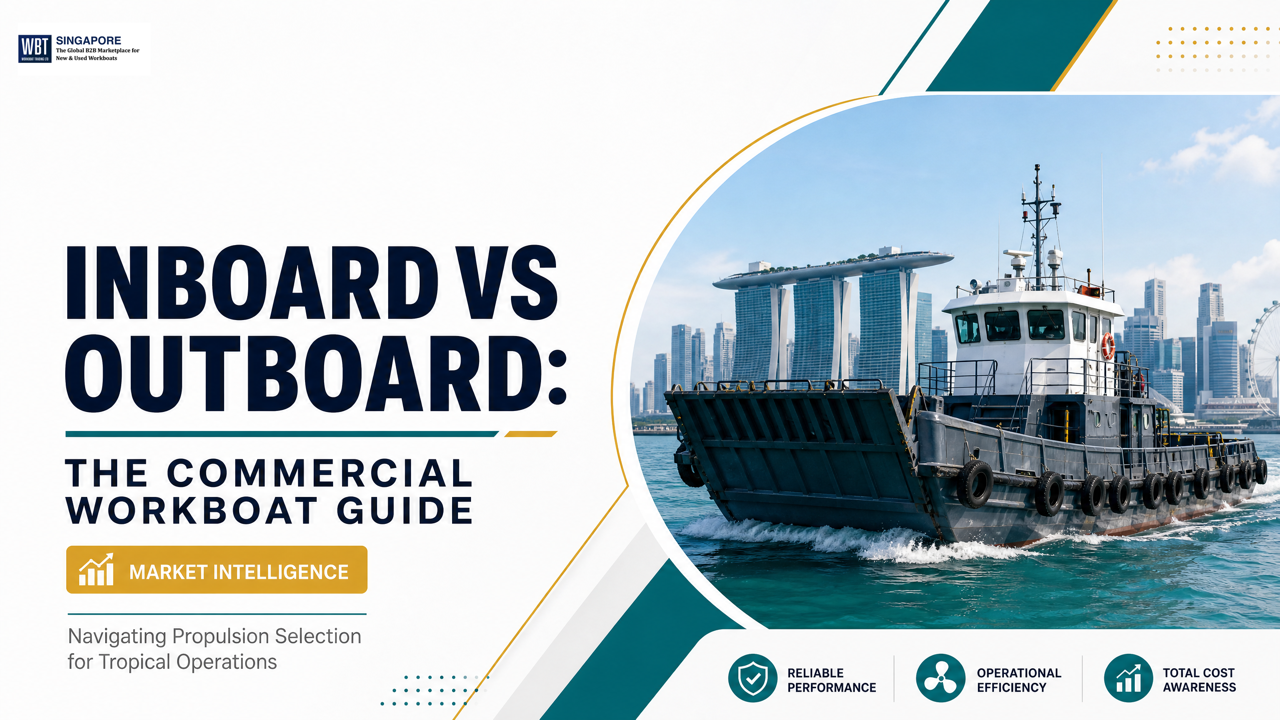
- The primary commercial workboat inboard vs outboard pros and cons depend on duty cycle, payload, bollard pull demand, maintenance model, fuel type, and operating environment.
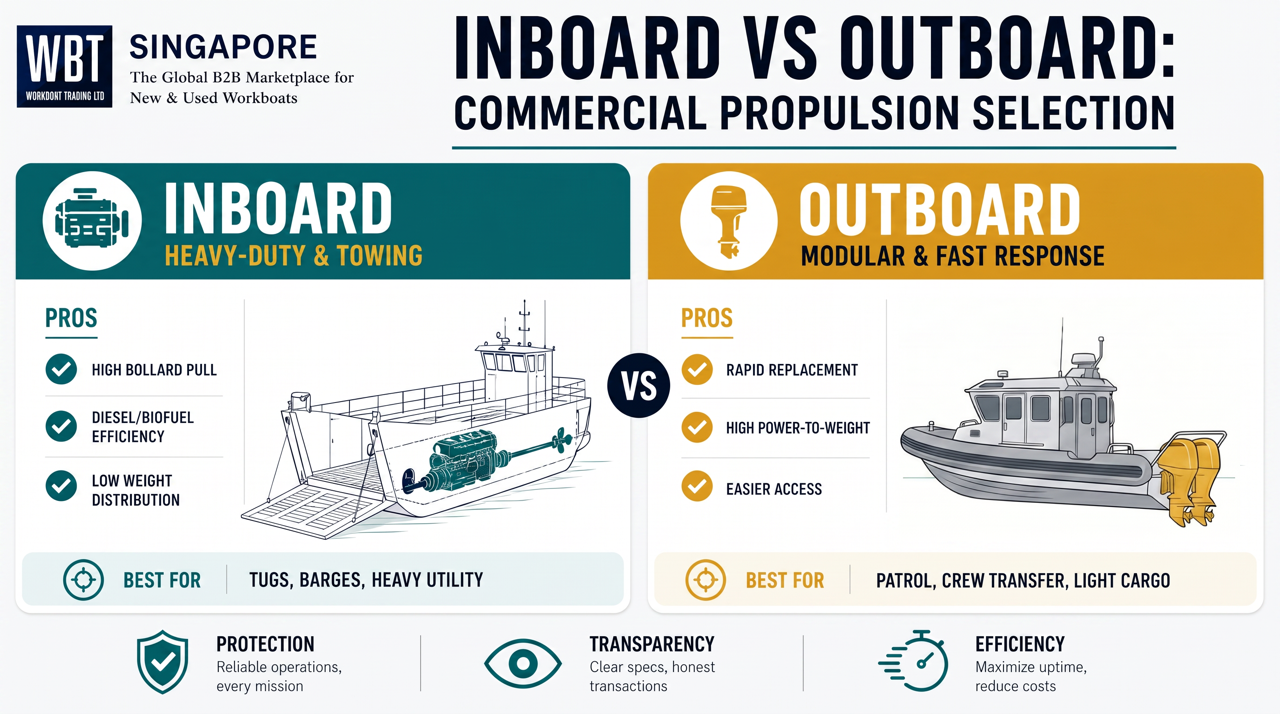
- Inboard propulsion generally provides stronger continuous-duty performance, better integration with diesel fuel systems, superior load-carrying balance, and higher suitability for heavy commercial operations.
- Outboard propulsion offers modular replacement, rapid repowering, easier access, and reduced downtime, but imposes higher transom loading and may be less efficient under heavy displacement duty.
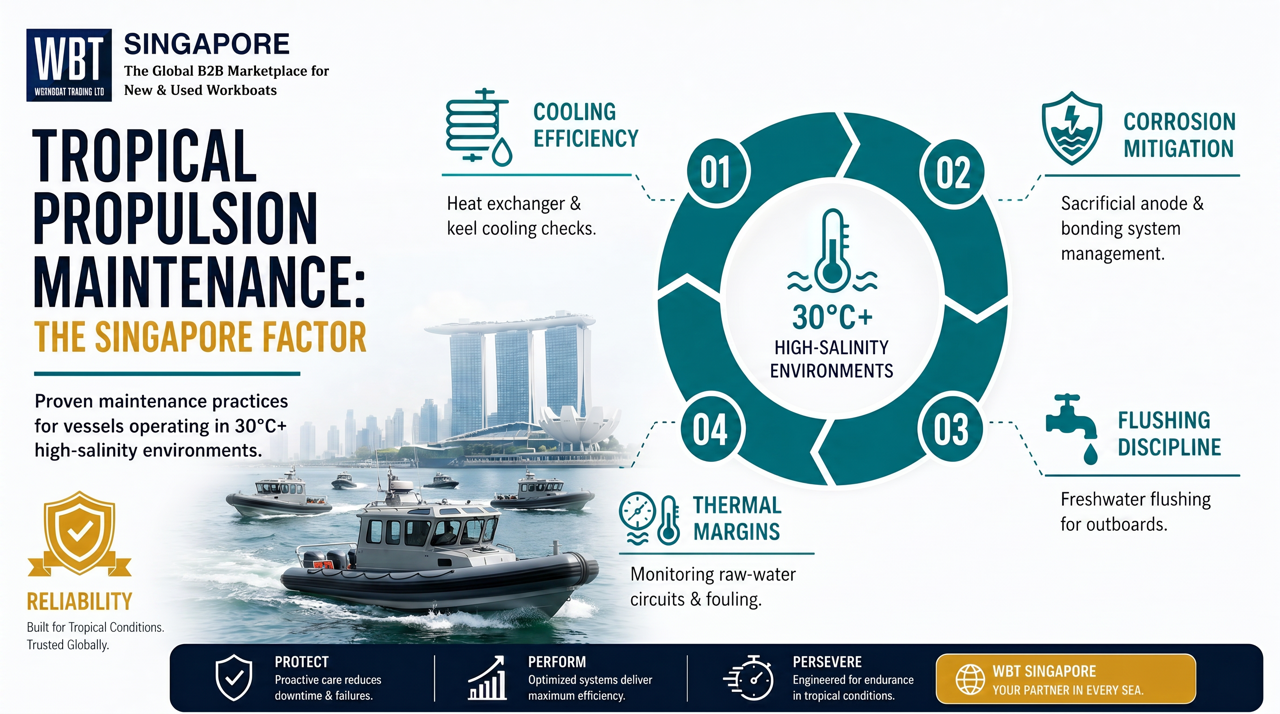
- In Singapore’s high-salinity, 30°C+ tropical waters, cooling-system design, corrosion mitigation, anode maintenance, and flushing discipline are critical to propulsion reliability.
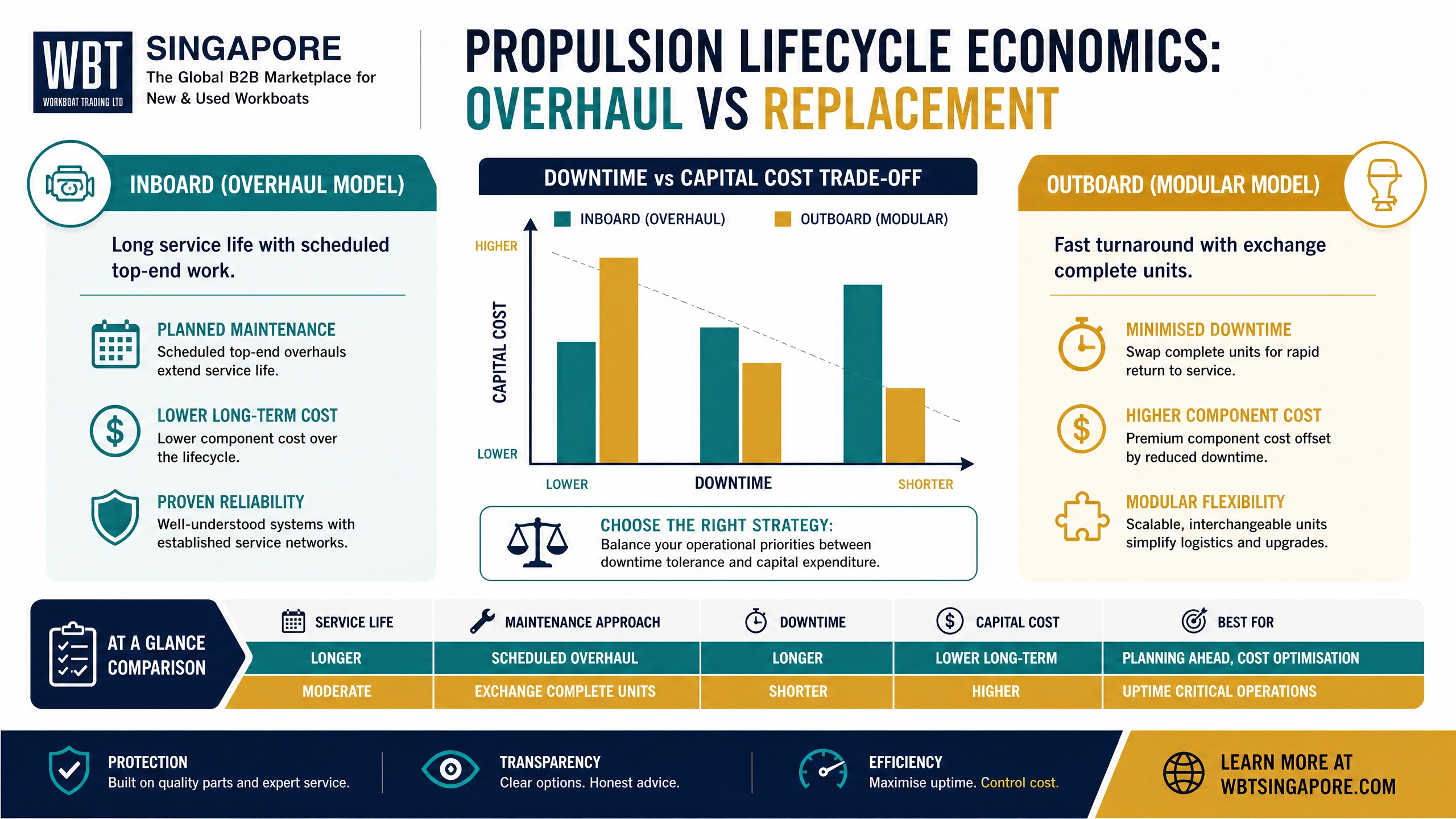
- For vessel life-cycle costs, inboards favour scheduled overhaul economics, while outboards favour modular replacement and fast operational turnaround.
Propulsion Selection in Commercial Workboats
Choosing between inboard propulsion and outboard propulsion is not a simple comparison of engine price. It is a naval architecture decision involving hull form, displacement, trim, machinery access, structural loading, hydrodynamic efficiency, maintenance philosophy, and maritime compliance. For commercial workboats in Singapore, the decision is further shaped by tropical seawater conditions, high utilisation, port operating constraints, and the sustainable maritime transition. A patrol craft, crew transfer boat, rescue boat, fish-farm support vessel, and harbour utility craft may all require different propulsion logic even at similar lengths.
Bollard Pull and Low-Speed Thrust
Inboard Propulsion
Bollard pull refers to the static pulling force a vessel can generate at zero forward speed. It is especially important for towing, pushing, station-keeping, and heavy harbour manoeuvring. Workboat stability and bollard pull calculations are treated seriously in commercial codes because towing force creates heeling moments and structural load cases. The UK Workboat Code, for example, includes bollard-pull-related stability considerations for towing operations.
Inboard systems usually perform better where continuous low-speed thrust is required. A diesel inboard connected to a reduction gearbox and large-diameter propeller can deliver strong thrust at lower propeller RPM. The deeper propeller position also improves immersion, reducing ventilation in chop or when the vessel is heavily loaded.
Outboard Propulsion
Outboards can provide excellent acceleration and manoeuvrability, particularly in lightweight planing hulls. Multiple outboards also provide redundancy: if one unit fails, the vessel may retain partial propulsion. However, outboards are usually limited by propeller diameter, gearcase size, and transom-mounted immersion. Under heavy tow or displacement conditions, they may ventilate more easily and lose effective thrust.
For fast patrol, crew transfer, or light cargo movement, outboards can be highly effective. For sustained towing, pushing, or heavy displacement work, inboards usually offer better bollard pull efficiency.
Specific Fuel Consumption and Duty Cycle
Diesel Inboards
Specific fuel consumption measures how much fuel an engine consumes to produce a unit of power, commonly expressed in g/kWh. Marine diesel engines are generally most efficient near optimal load and less efficient at very low load or idle; published marine engine references commonly place optimal diesel SFC in a broad range around 155–225 g/kWh depending on engine type and operating point.
Diesel inboards are therefore advantageous for commercial vessels running long hours at predictable load. They also align better with B100 biofuel pathways, which may become relevant under Singapore MPA harbour craft regulations 2030.
Petrol and Diesel Outboards
Outboards have historically been petrol-dominated, although diesel outboards are increasingly available for commercial users. Diesel outboards can offer better fuel efficiency than petrol outboards because diesel has higher energy density and compression-ignition engines operate more efficiently under many commercial load profiles. Petrol outboards remain attractive for lower initial cost, lower weight, and high power-to-weight ratio. However, for vessels operating daily in harbour service, fuel cost can dominate vessel life-cycle costs. The correct comparison should therefore use fuel burn per mission, not fuel burn per engine hour alone.
Transom Loading and Hull Structure
Outboard Weight Concentration
Transom loading is one of the most important structural disadvantages of outboard propulsion. Modern high-horsepower outboards are heavy, and multiple installations concentrate static and dynamic loads at the stern. This affects trim, acceleration, following-sea behaviour, deck drainage, and reserve buoyancy aft.
A poorly matched outboard installation may produce stern squat, increased drag, reduced hydrodynamic efficiency, and higher fuel consumption. Naval architecture assessment should include transom scantlings, bracket design, engine setback, splashwell geometry, longitudinal centre of gravity, and freeboard aft.
Inboard Weight Distribution
Inboard propulsion allows machinery weight to be placed lower and further forward. This can improve trim, reduce stern loading, and create more predictable seakeeping. The disadvantage is loss of internal volume, increased shaftline complexity, and more demanding machinery-space ventilation, fire safety, and access requirements.
The Singapore Factor: Tropical Waters and Corrosion
Cooling-System Efficiency
Singapore’s harbour environment combines high salinity, warm seawater, high humidity, and frequent low-speed operation. Engines operating in 30°C+ ambient conditions have reduced thermal margins. Raw-water cooling circuits face fouling, scale, debris ingestion, and salt crystallisation risk.
Outboards typically require disciplined freshwater flushing to remove salt from cooling passages. Mercury Marine’s maintenance guidance, for example, highlights flushing as a method to clear corrosive saltwater from the cooling system after use.
Inboards may use heat exchangers, keel cooling, or raw-water circuits. Heat-exchanger and keel-cooled systems can improve durability, but they introduce maintenance points such as seawater pumps, strainers, anodes, coolant condition, and exchanger cleaning.
Corrosion Mitigation
Saltwater corrosion is not a cosmetic issue; it is a propulsion reliability issue. Operators should manage sacrificial anodes, bonding systems, coating integrity, stainless fastener compatibility, aluminium housing protection, and galvanic isolation. In high-salinity tropical operations, deferred corrosion maintenance can rapidly become gearbox, bracket, cooling, or steering failure.
Maintenance Economics: Modular Replacement vs Overhaul
Outboard Modular Replacement
The strongest commercial argument for outboards is the modular replacement model. A failed outboard can often be removed and replaced faster than an inboard engine can be overhauled. This is valuable for operators where downtime is more expensive than component cost.
Outboards also simplify workshop logistics. Instead of immobilising the vessel for major engine work, the operator can exchange a complete unit and repair the failed engine off-vessel.
Inboard Overhaul Model
Inboards favour the overhaul model. A properly maintained marine diesel can undergo scheduled top-end work, injector servicing, turbocharger overhaul, cooling-system refurbishment, and gearbox maintenance over a long service life. This suits operators with planned downtime, engineering support, and high annual running hours. The trade-off is that major inboard work is more invasive. Access constraints, shaft alignment, lifting arrangements, and machinery-space layout can extend yard time.
Strategic Selection Guidance
For high-speed, light-duty, rapid-response workboats, outboards offer strong manoeuvrability, redundancy, and maintenance flexibility. For heavy-duty, high-hour, displacement, towing, or load-carrying vessels, inboards usually provide stronger lifecycle economics, fuel efficiency, and propulsion integration. The best decision is not “inboard versus outboard” in isolation. It is a whole-vessel optimisation problem involving hull form, route profile, payload, fuel strategy, cooling architecture, corrosion exposure, Singapore port dues, and long-term maritime compliance.
FAQ
Are inboard engines better than outboards for commercial workboats?
Inboards are generally better for heavy-duty, high-hour, towing, and displacement operations. Outboards are often better for lightweight, fast-response, and modular maintenance applications.
Which has better fuel economy: inboard or outboard?
Diesel inboards usually provide better fuel economy for long commercial duty cycles. Petrol outboards can be efficient in light, fast craft, but fuel burn often increases under heavy load or displacement operation.
Why is transom loading important for outboard workboats?
Outboards concentrate engine weight and thrust loads at the stern. Excessive transom loading can reduce freeboard aft, worsen trim, increase drag, and impose structural fatigue on the hull.
How does Singapore’s tropical seawater affect propulsion systems?
Warm, high-salinity seawater increases cooling-system stress and corrosion risk. Operators must prioritise flushing, anode replacement, heat-exchanger maintenance, coating protection, and regular inspection.