Executive Summary: Key Technical Insights
- Commercial workboats are purpose-built vessels designed for specific maritime functions including towing, patrol, rescue, survey, dredging, and offshore support – they are not recreational craft.
- The nine primary workboat categories are: rigid inflatable boats (RIBs), patrol and security vessels, rescue and fast rescue boats, lifeboats and freefall boats, survey and hydrographic boats, push and tug boats, hybrid and autonomous vessels, dredging boats, and general workboats.
- Tug boats deliver high bollard pull for towing and harbour manoeuvring, while RIBs prioritise speed and agility for crew transfer and rapid-response operations.
- Patrol vessels are engineered for maritime law enforcement and coastal surveillance, whereas rescue boats must meet strict SOLAS self-righting and buoyancy standards.
- Hybrid and autonomous workboats are gaining commercial relevance as regulations like Singapore's MPA 2030 mandate push the industry toward zero-emission propulsion.
- Selecting the right workboat category depends on the vessel's intended duty cycle, required speed and payload, sea-state operating limits, regulatory environment, and long-term fleet strategy.
Why Understanding Workboat Categories Matters
The term "workboat" covers a broad spectrum of commercial vessels, each engineered for a specific maritime function. Unlike recreational craft, workboats are purpose-built tools designed to operate under demanding commercial, industrial, or governmental conditions. Whether you are entering the maritime industry for the first time, expanding an existing fleet, or evaluating vessels for a specific contract, understanding the differences between workboat categories is the first step toward making the right acquisition decision.
This guide covers the nine primary categories of commercial workboats commonly found in the global marketplace, with a focus on how each type is used in real-world maritime operations.
Rigid Inflatable Boats (RIBs)
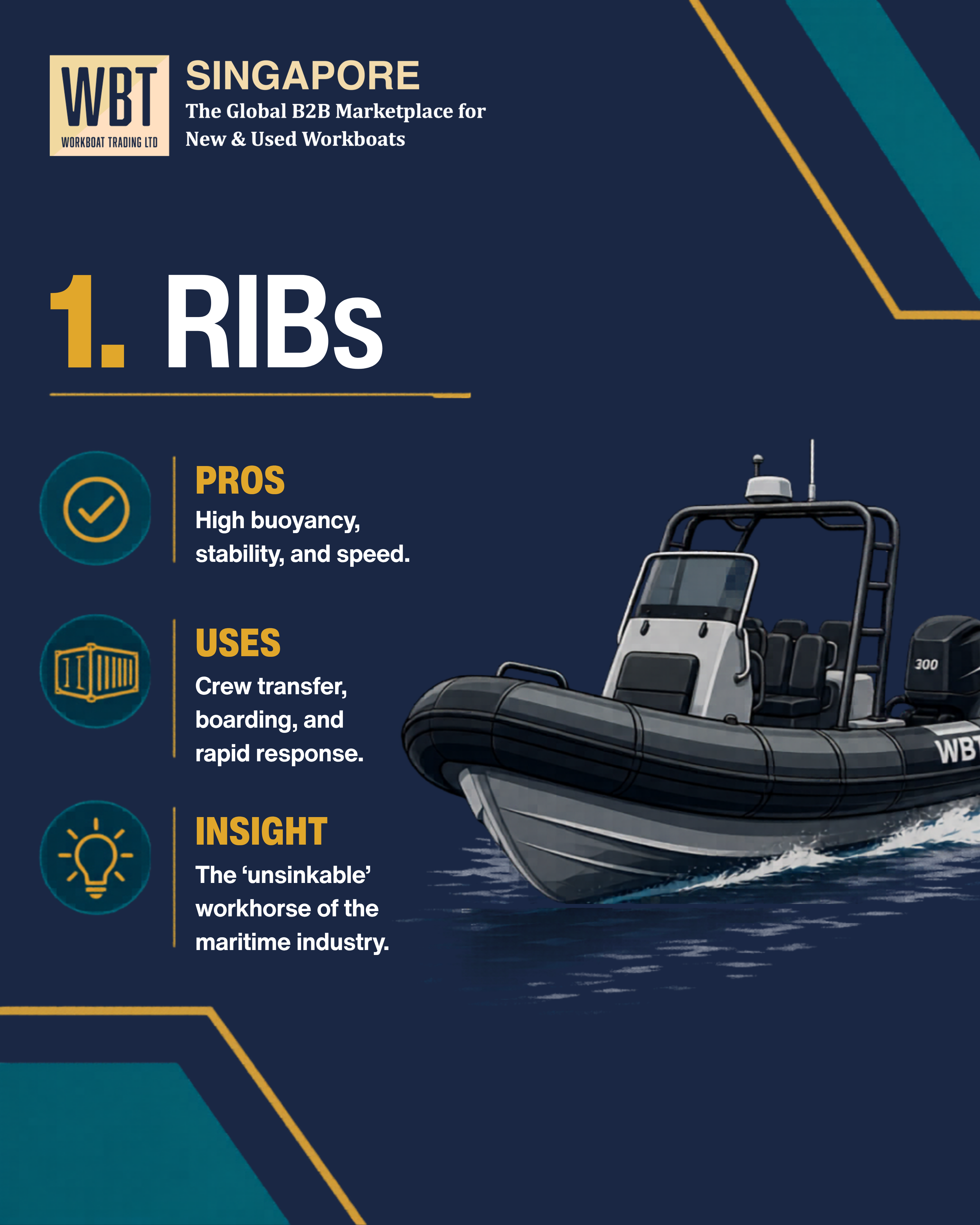
A rigid inflatable boat combines a solid fibreglass or aluminium hull with inflatable tube sponsons along the gunwales. This hybrid construction gives RIBs an exceptional strength-to-weight ratio, making them highly manoeuvrable and capable of operating in rough sea states. Commercial RIBs are commonly used for crew transfer, dive support, port security, and rapid-response operations. Their shallow draft and high speed-to-length ratio make them ideal for inshore and nearshore tasking where agility is more valuable than cargo capacity.
Patrol and Security Vessels
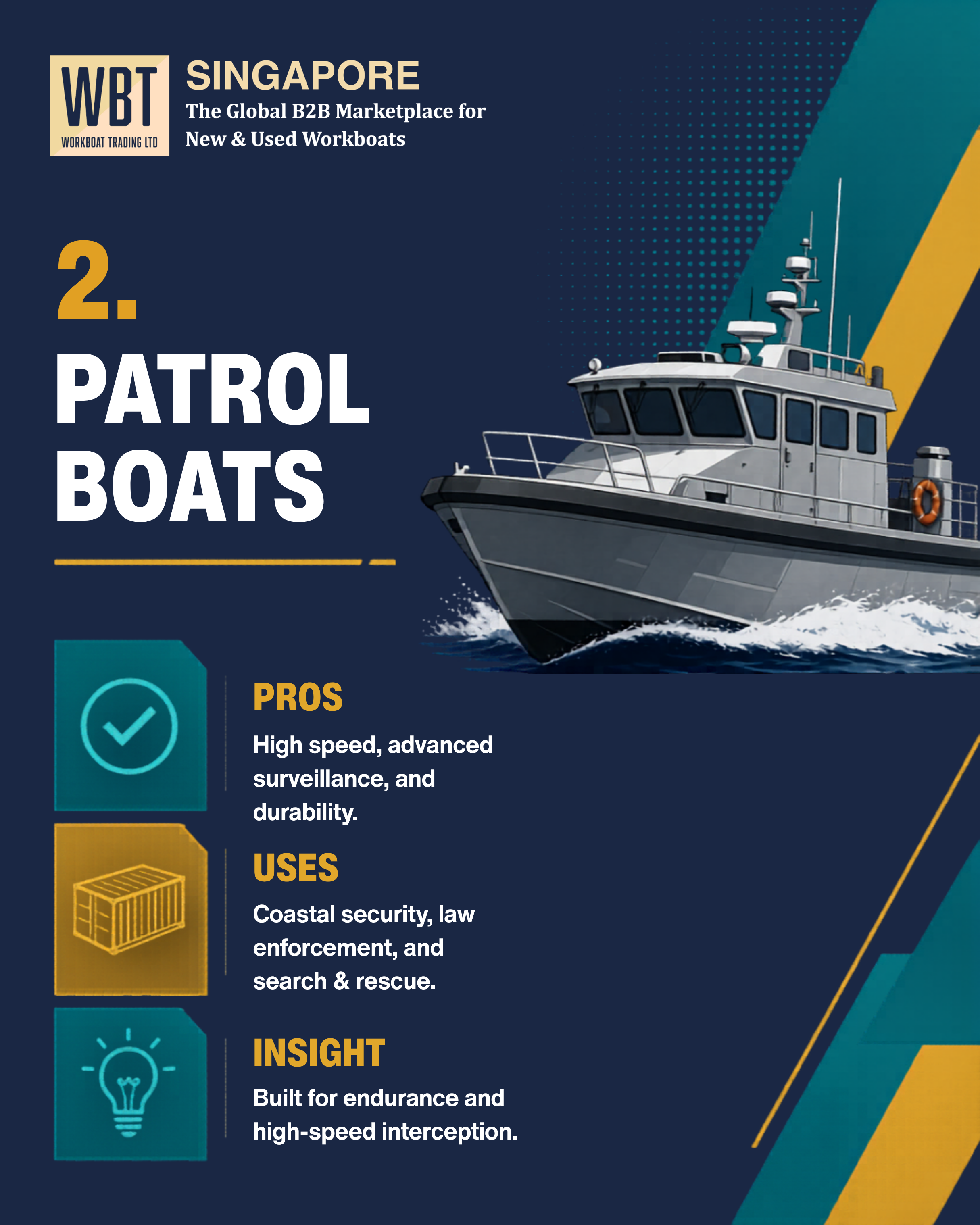
Patrol and security vessels are high-speed craft designed for maritime law enforcement, coastal surveillance, border protection, and port security. These vessels typically feature reinforced hull structures, radar and communications arrays, weapon mounting points, and crew-protection systems. Hull forms range from deep-vee monohulls to catamaran configurations, depending on the operational profile. Government agencies, coast guards, and private maritime security companies rely on patrol craft to maintain domain awareness and enforce maritime regulations across territorial waters.
Rescue and Fast Rescue Boats
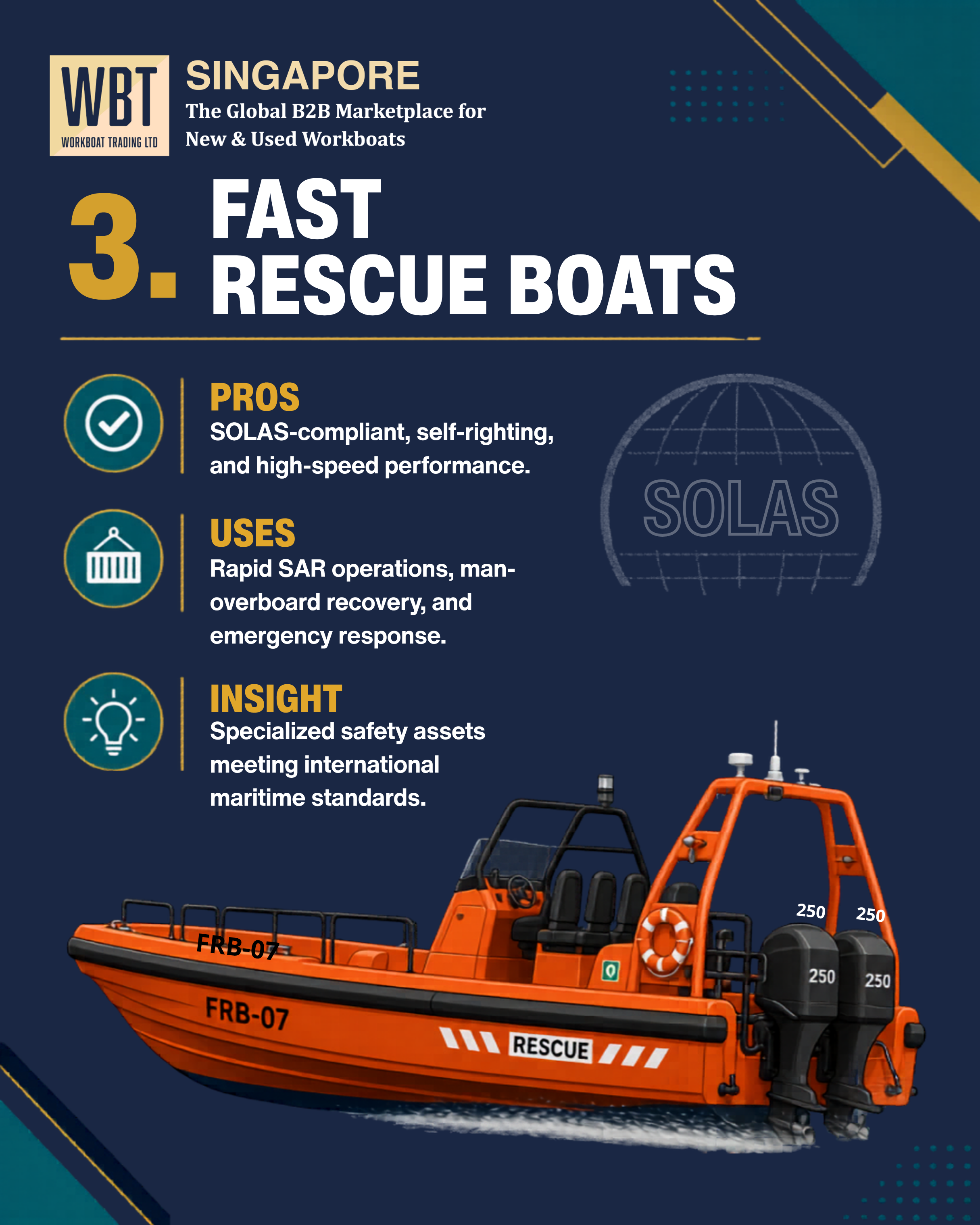
Rescue boats and fast rescue craft are specialised response vessels designed for search-and-rescue (SAR) operations and man-overboard recovery. Fast rescue boats (FRBs) are typically davit-launched from offshore platforms or larger vessels, while standalone rescue boats may operate from shore stations. Key design requirements include self-righting capability, high reserve buoyancy, protected propulsion, and the ability to recover casualties from the water in adverse conditions. These vessels are governed by strict SOLAS (Safety of Life at Sea) and flag-state regulations.
Lifeboats and Freefall Boats
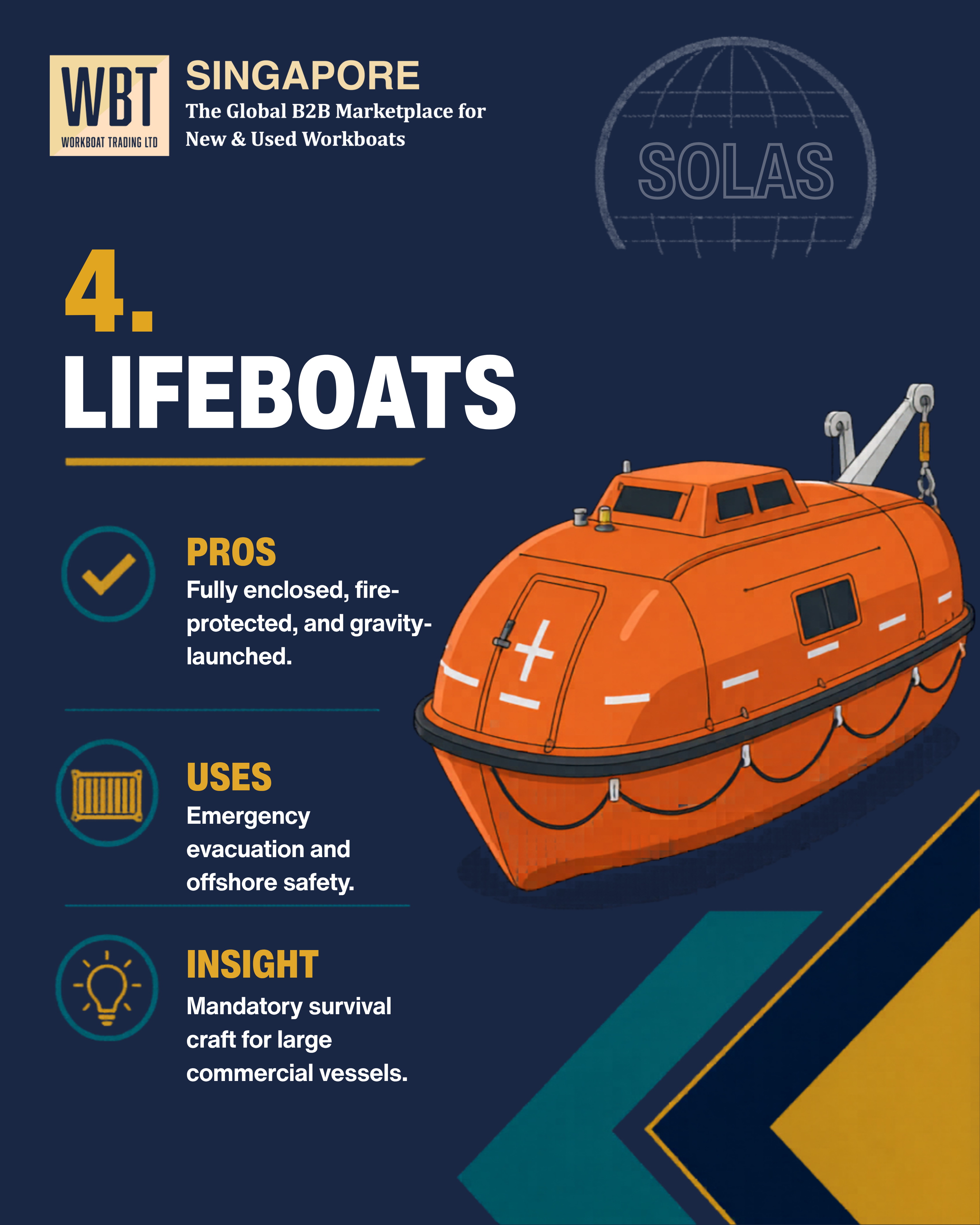
Lifeboats and freefall lifeboats are SOLAS-compliant evacuation systems installed on offshore platforms, FPSOs, and large commercial ships. Freefall lifeboats are designed to launch by sliding down a ramp and entering the water at speed, allowing rapid evacuation in emergency scenarios including fire and structural failure. Totally enclosed lifeboats provide environmental protection for occupants during abandonment. These are highly regulated life-saving appliances, and their purchase, maintenance, and certification must comply with IMO standards and classification society rules.
Survey and Hydrographic Boats
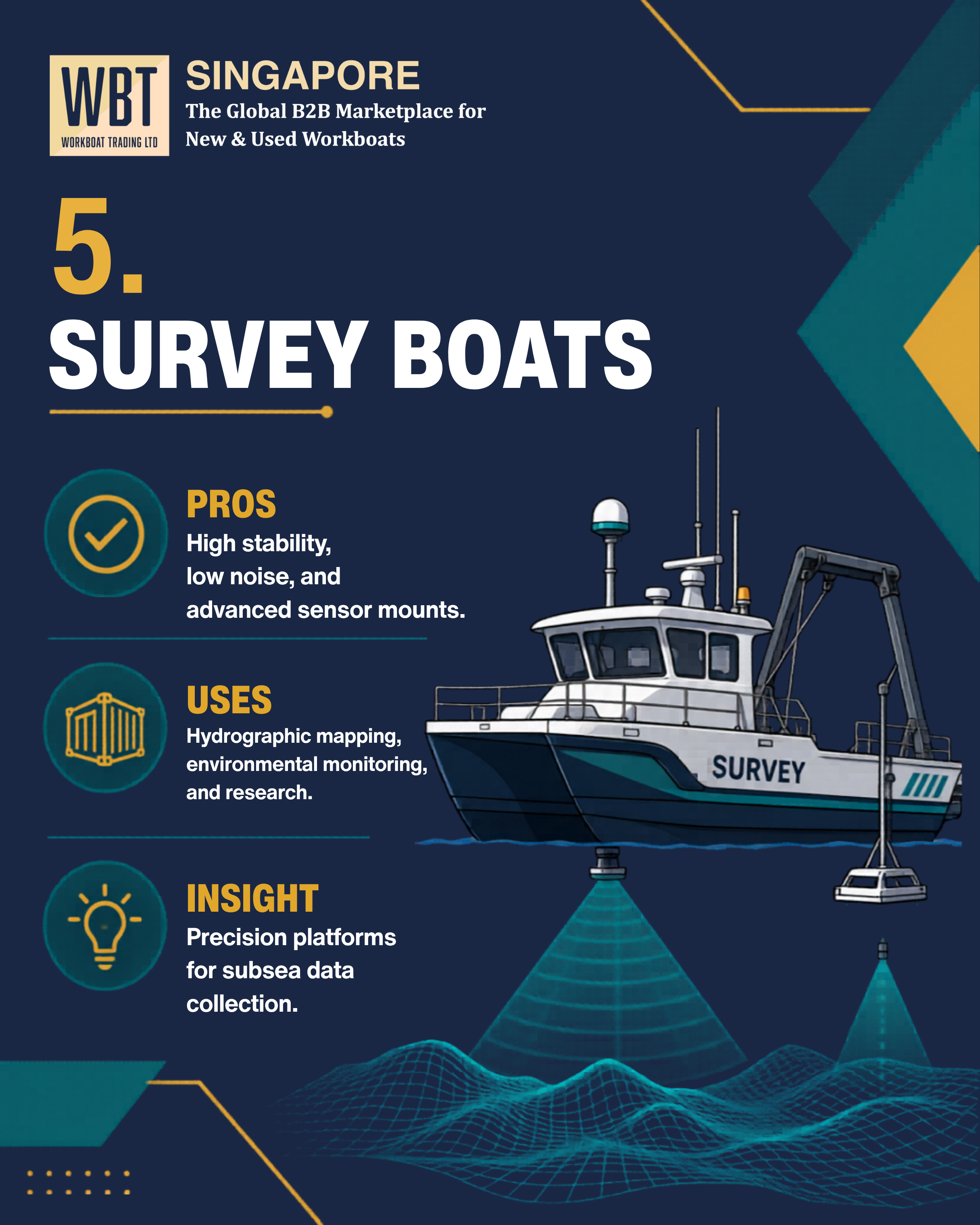
Survey and hydrographic boats are stable platforms equipped with multibeam echo sounders, side-scan sonar, GPS positioning systems, and data-acquisition hardware for seabed mapping, bathymetric survey, environmental monitoring, and underwater inspection. Hull form and stability are critical: these vessels must maintain a predictable motion profile to ensure accurate data collection. Survey boats serve port authorities, dredging companies, marine construction firms, and environmental agencies. Many feature low-noise propulsion to reduce acoustic interference with survey instruments.
Push and Tug Boats
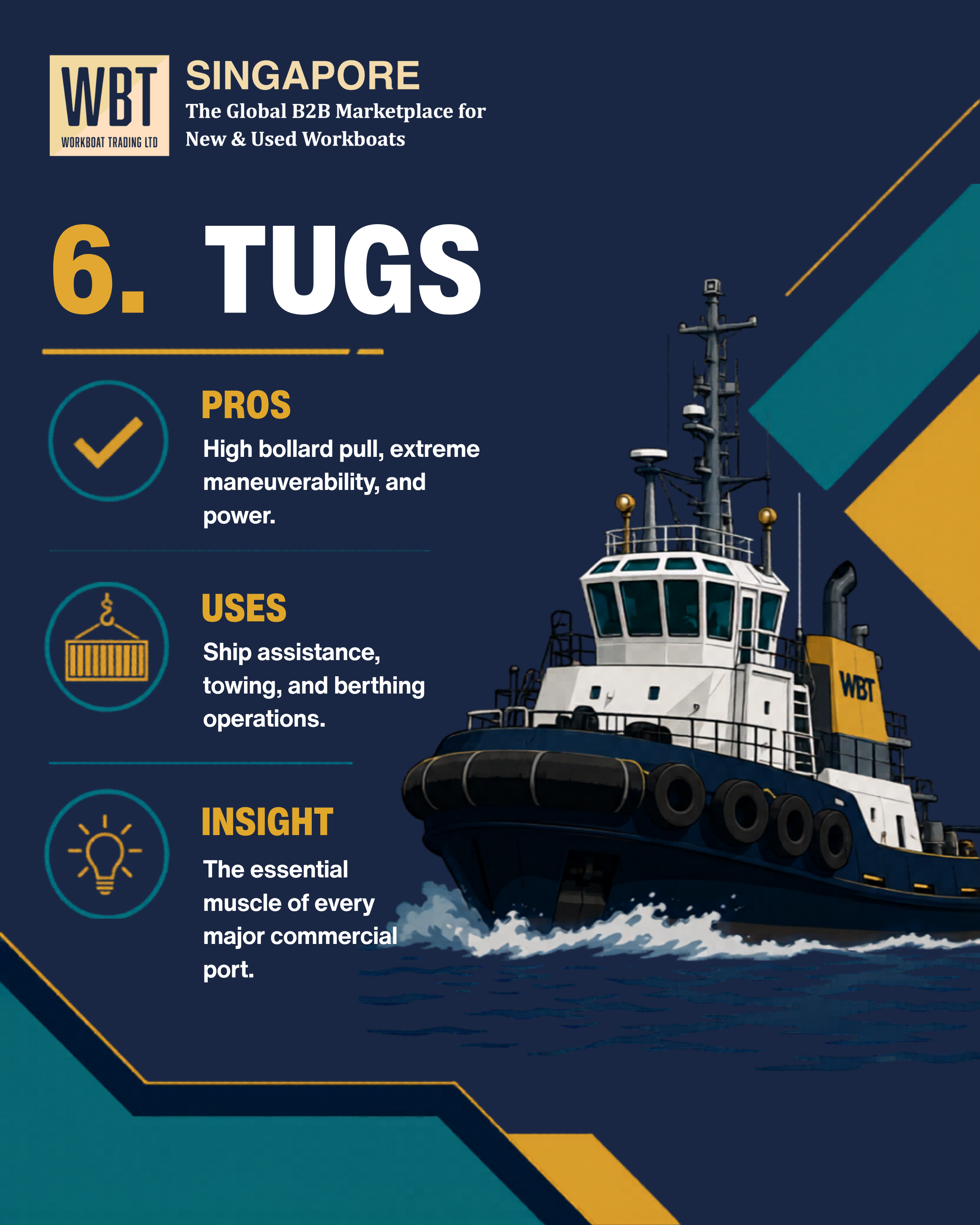
Tug boats are the heavy-duty workhorses of the maritime world, delivering high bollard pull for towing, pushing, and manoeuvring larger vessels in ports, harbours, and offshore locations. Tugs are categorised by function – harbour tugs, ocean-going tugs, anchor-handling tugs, and push boats for inland barge operations. Key specifications include bollard pull (measured in tonnes), engine power, winch capacity, and fendering arrangement. Propulsion systems vary from conventional shaft-driven propellers to azimuth thrusters and Voith Schneider units, each offering different manoeuvrability characteristics. For a deeper comparison of propulsion options, see our technical guide on inboard vs outboard motors for workboats.
Hybrid and Autonomous Vessels
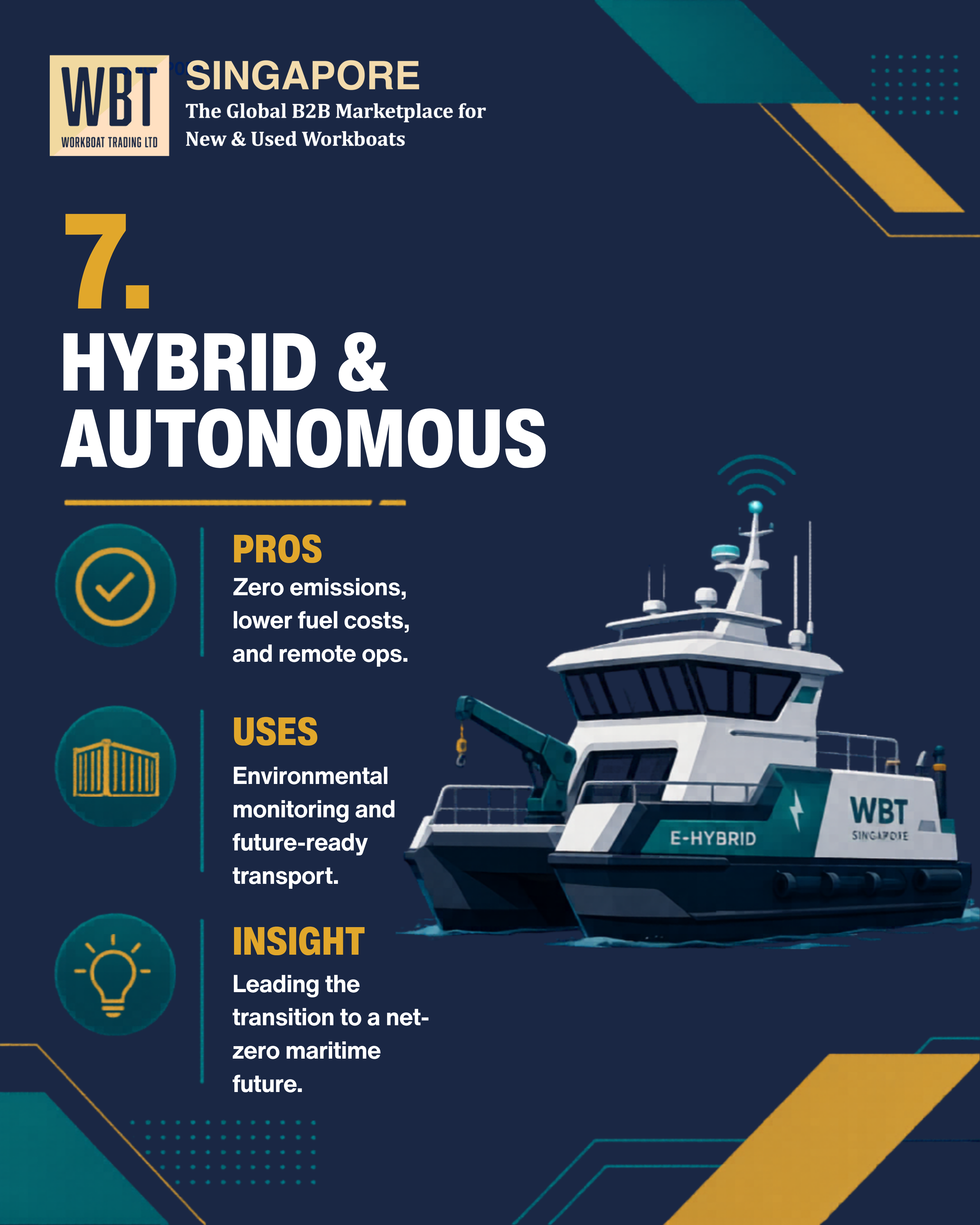
Hybrid and autonomous vessels represent the next generation of commercial marine technology. Hybrid workboats combine conventional diesel engines with electric propulsion motors and battery storage, reducing fuel consumption and emissions during low-speed or standby operations. Fully autonomous vessels use sensor arrays, AI-based navigation, and remote-control systems to operate without onboard crew. These platforms are increasingly relevant for port survey, environmental monitoring, and harbour operations – particularly in Singapore, where the MPA 2030 mandate is driving fleet operators toward zero-emission propulsion.
Dredging Boats
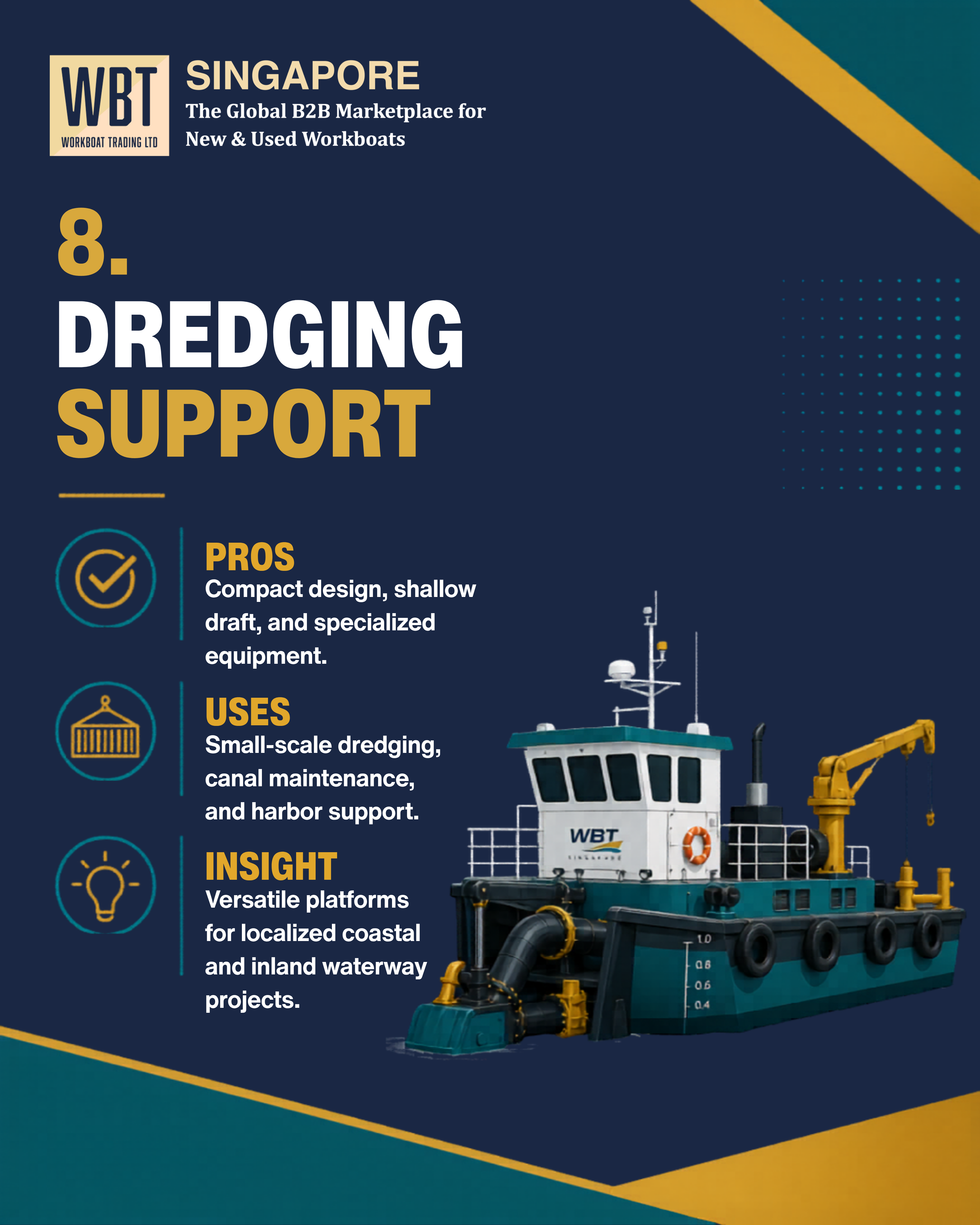
Dredging vessels are specialised workboats fitted with mechanical excavation arms, cutter heads, or suction systems to remove sediment, silt, and debris from waterways, ports, and coastal zones. Dredging is essential for maintaining navigable channel depths, preparing construction sites, and supporting land reclamation projects. Smaller dredging boats are used for harbour maintenance and environmental remediation, while larger trailing suction hopper dredgers serve major infrastructure projects. Operators should assess hopper capacity, dredging depth, pump flow rate, and discharge method when evaluating a dredging vessel.
General Workboats
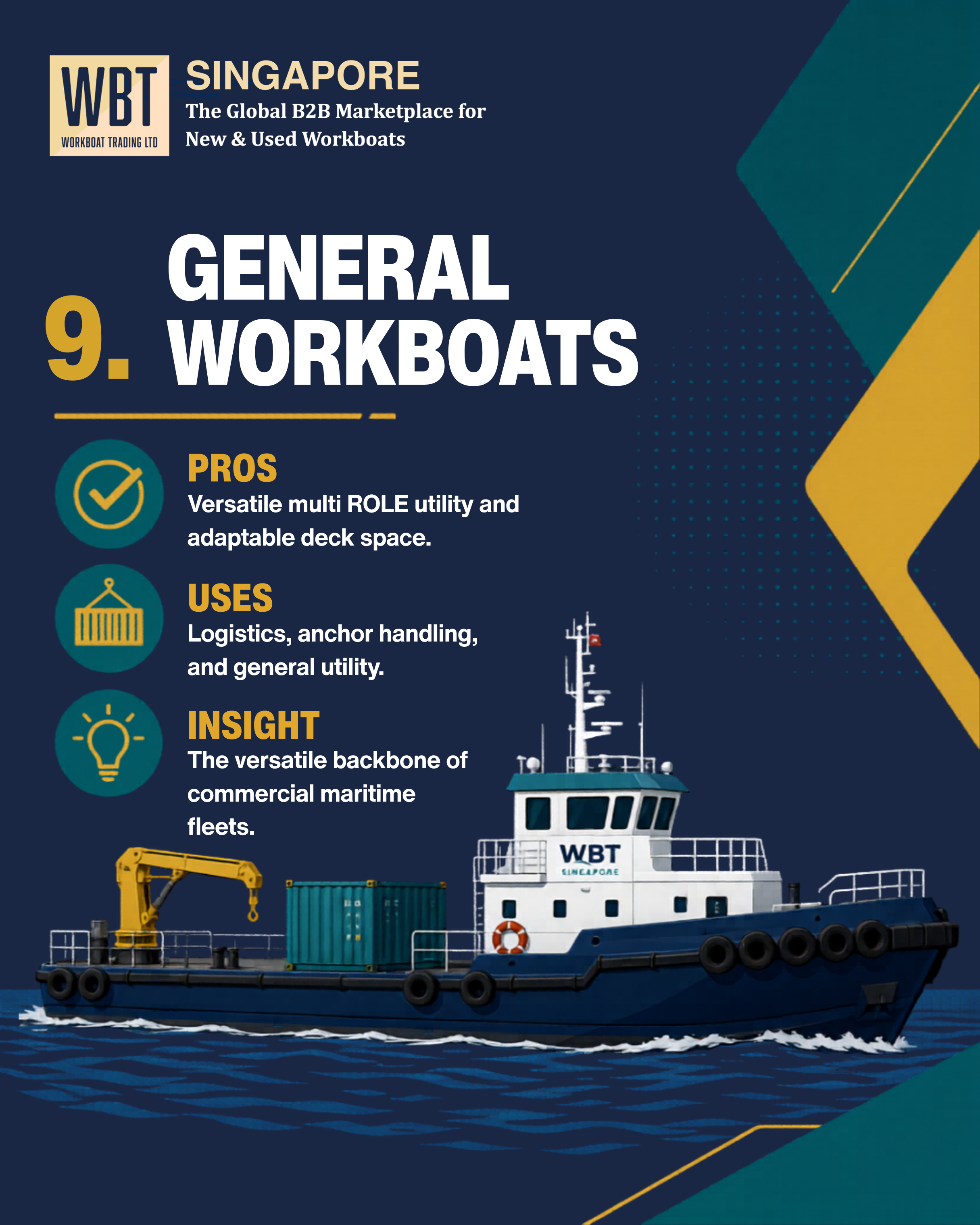
General workboats are versatile, multi-role utility vessels designed to perform a range of maritime tasks including crew transfer, light cargo delivery, anchor handling, dive support, and offshore logistics. These vessels are the backbone of many commercial fleets because they can be adapted to different roles without requiring a specialised hull form. General workboats are commonly found supporting offshore energy platforms, aquaculture farms, port operations, and marine construction projects.
How to Choose the Right Workboat Category
Selecting the right type of workboat depends on your operational requirements, regulatory environment, budget, and long-term fleet strategy. Consider the vessel's primary duty cycle, required speed and payload, sea-state operating limits, and crew accommodation needs. If you are new to the workboat market, browsing verified listings across multiple categories is the best way to compare specifications, pricing, and availability.
For buyers evaluating their first workboat purchase, our upcoming guide on how to buy a used workboat covers everything from pre-purchase inspections to understanding class certificates.
FAQ
What is a workboat?
A workboat is any commercial vessel designed for a specific maritime task such as towing, patrol, survey, rescue, dredging, or crew transfer. Unlike recreational boats, workboats are engineered for heavy-duty, high-utilisation commercial operations.
What are the most common types of workboats?
The most common types include tug boats, patrol vessels, rigid inflatable boats (RIBs), survey boats, rescue craft, lifeboats, dredging vessels, general workboats, and hybrid or autonomous platforms.
How do I choose the right type of workboat?
Start by defining your operational requirements: what task does the vessel need to perform, in what conditions, and for how many hours per day? Match those requirements against the vessel categories to narrow down your search. Browse workboat listings on WBT to compare specifications across categories.
Where can I buy a workboat?
WBT (Workboat Trading) is a dedicated B2B marketplace for commercial workboats, connecting buyers and sellers globally. You can browse verified listings, filter by vessel type, and contact sellers directly through the platform.