
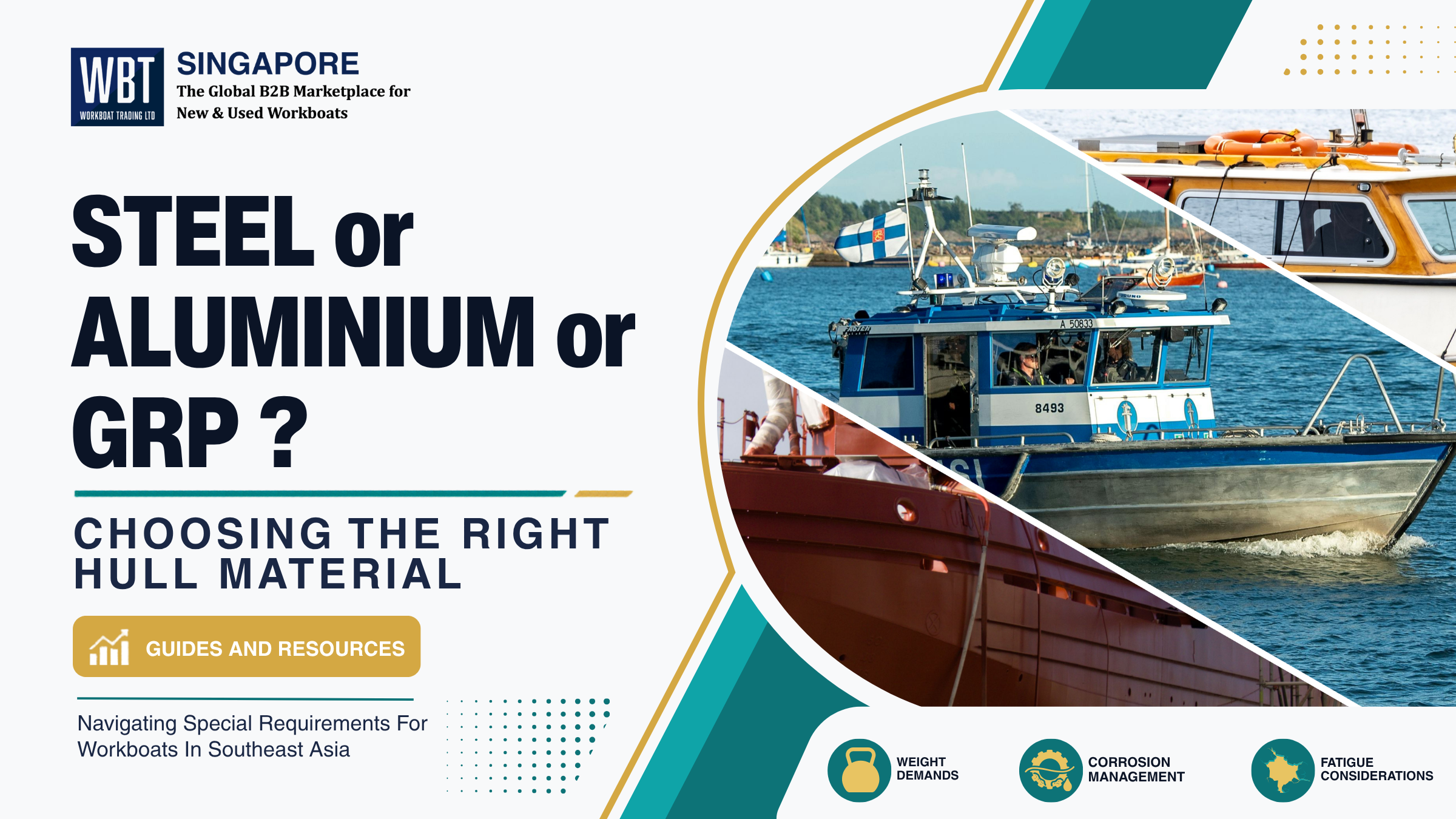
Executive Summary: Key Technical Insights
- Steel, aluminium, and GRP each impose fundamentally different design constraints on workboat hull structure, propulsion integration, corrosion management, and lifecycle maintenance costs.
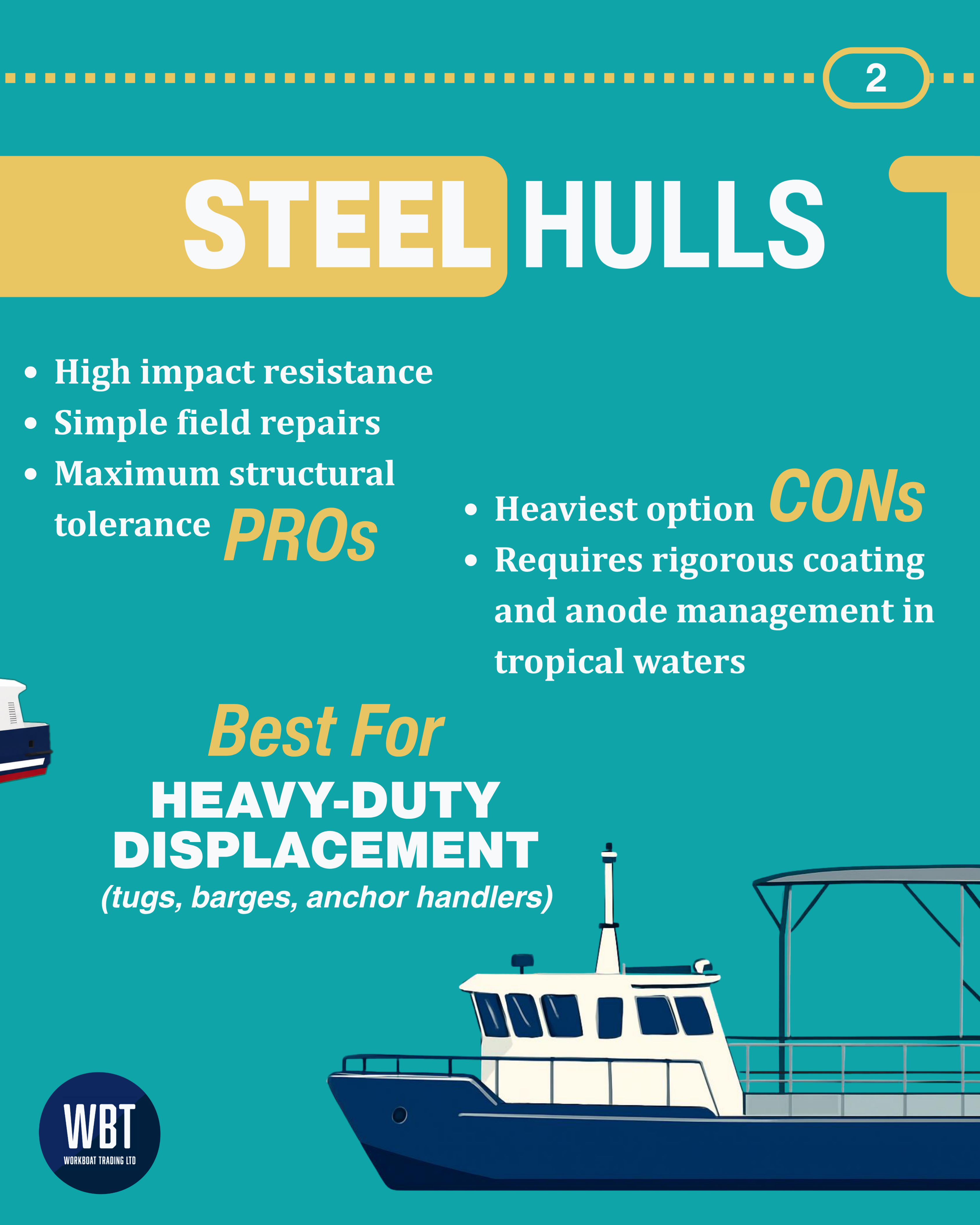
- Steel hulls offer the highest structural tolerance, easiest field repair, and strongest compliance position for heavy commercial operations, but carry the heaviest weight penalty and the most demanding corrosion maintenance requirements in tropical saltwater.
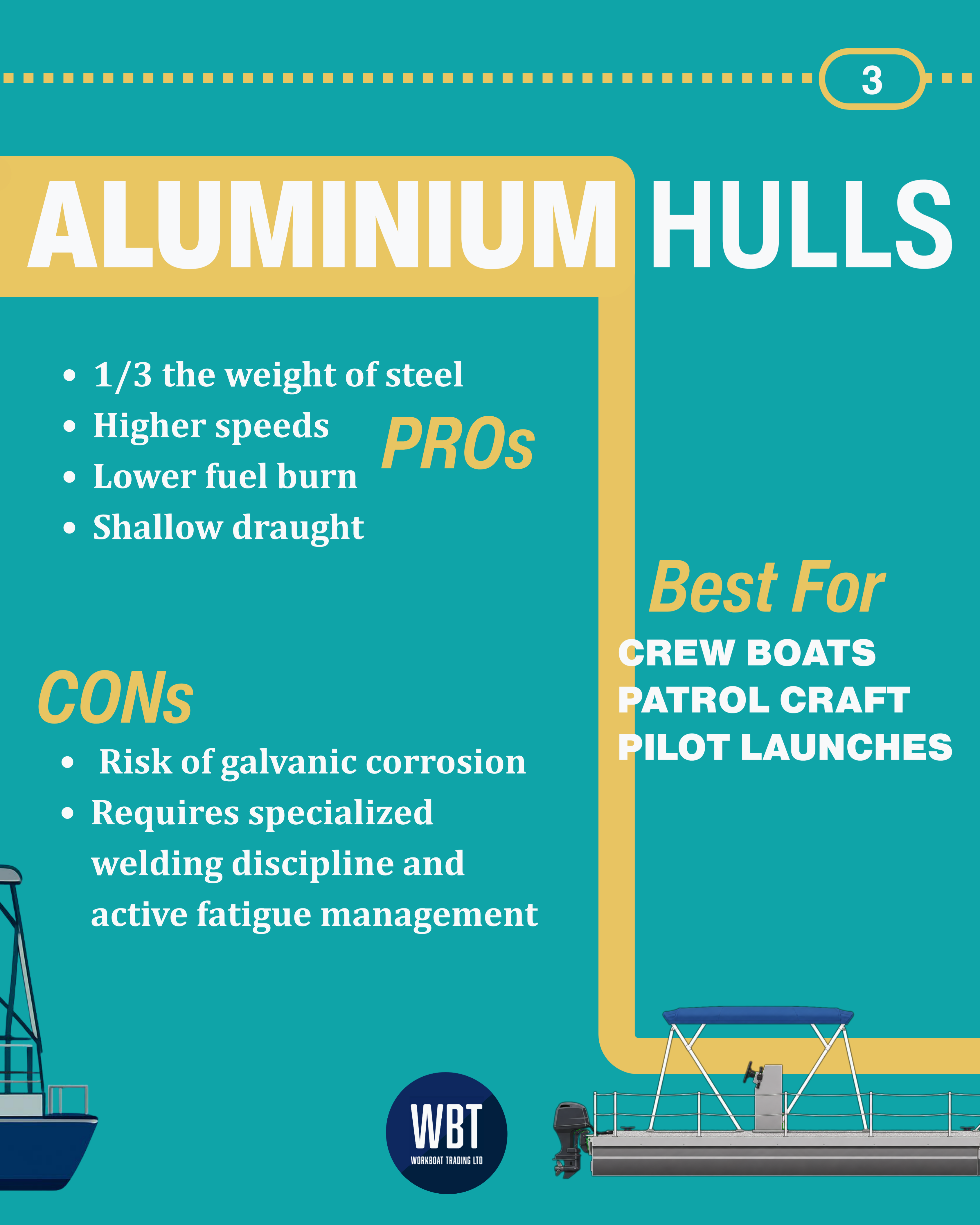
- Marine-grade aluminium (5083/6061 alloys) delivers significant weight reduction and naturally resists surface corrosion, making it well-suited for high-speed crew boats, patrol craft, and vessels requiring shallow draught — but demands strict welding discipline, galvanic isolation, and careful management of fatigue cracking.
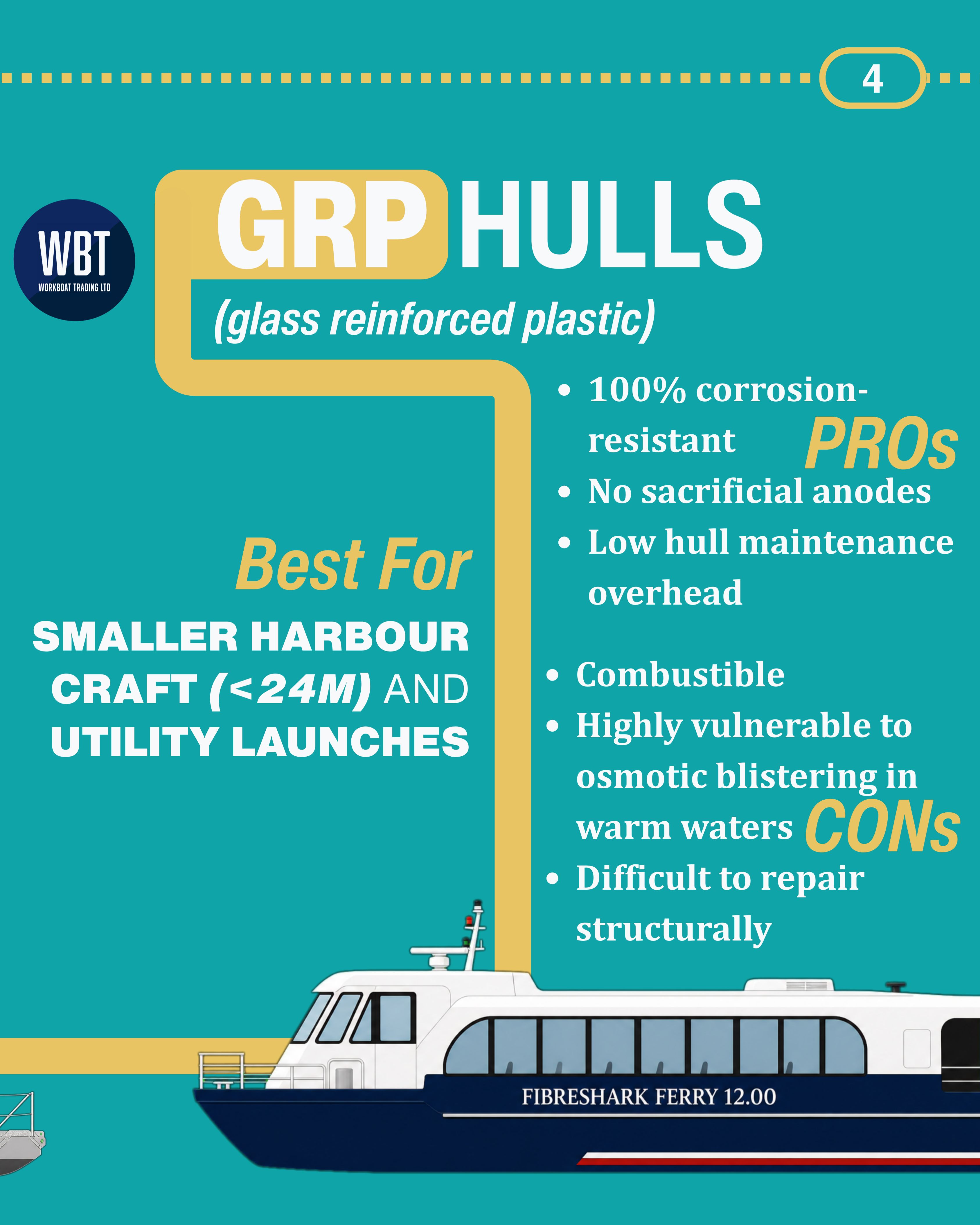
- GRP construction provides excellent moulded corrosion resistance and low recurring hull maintenance, making it attractive for smaller harbour utility craft — but imposes fire performance limitations, complicates structural repair after impact damage, and is generally less suitable for heavy displacement or high-bollard-pull operations.
- For the Singapore workboat market, hull material selection directly affects vessel resale value, insurance classification, charter eligibility, and compliance with the MPA 2030 decarbonisation mandate.
Why Hull Material Selection Matters for Commercial Workboats
Hull material is not a cosmetic specification. It is the single most consequential structural decision in workboat design, determining the vessel's weight distribution, propulsion efficiency, fatigue life, damage tolerance, fire safety classification, maintenance schedule, and residual market value. For operators in Southeast Asia — particularly Singapore, Indonesia, Malaysia, and the Philippines — the selection must also account for year-round tropical seawater exposure, high ambient temperatures, biofouling intensity, and the growing regulatory pressure toward sustainable maritime operations.
A vessel built for the wrong operating environment will accumulate disproportionate maintenance costs, suffer accelerated structural degradation, and ultimately trade at a discount in the B2B vessel marketplace. Understanding the engineering trade-offs between steel, aluminium, and GRP is therefore essential for any buyer, seller, or fleet manager evaluating commercial workboat assets.
Steel Hulls
Structural Performance
Mild steel and higher-tensile shipbuilding steels remain the most widely used hull materials for commercial displacement workboats above approximately 15 metres in length. Steel provides high yield strength, excellent impact resistance, and predictable fatigue behaviour under repeated loading. For vessels engaged in towing, pushing, heavy cargo carriage, anchor handling, or operations requiring substantial bollard pull, steel offers the structural margin that naval architects require.
Steel is also the material of choice where classification society rules demand proven structural fire protection. In machinery spaces, fuel tank boundaries, and collision bulkheads, steel provides inherent fire resistance without requiring additional insulation or fire-retardant treatment.
Corrosion Management in Tropical Waters
The primary disadvantage of steel in Southeast Asian operations is corrosion. Singapore's harbour waters — with salinity levels typically between 30–33 PSU and year-round sea surface temperatures exceeding 28°C — create an aggressive electrochemical environment. Unprotected mild steel corrodes rapidly in these conditions.
Effective corrosion management for steel workboats requires a multi-layered approach: blast-cleaned surface preparation to SA 2.5 or equivalent, high-build marine epoxy coating systems, cathodic protection using sacrificial zinc or aluminium anodes, and disciplined drydocking intervals for coating renewal. Operators who defer hull coating maintenance in tropical waters will face accelerated plate wastage, pitting corrosion at weld seams, and potential classification deficiencies at annual survey.
Repair and Modification
Steel's strongest commercial advantage is repairability. Damaged steel plate can be cropped and renewed using standard shipyard welding equipment available throughout Southeast Asia. Structural modifications — such as adding towing bitts, reinforcing decks for crane installations, or extending superstructure — are straightforward in steel construction. This repairability contributes directly to longer economic life and stronger residual value in the second-hand vessel market.
Aluminium Hulls
Weight Advantage and Speed
Marine-grade aluminium alloys — primarily 5083 for hull plate and 6061-T6 for extruded structural sections — offer a density approximately one-third that of steel. This weight reduction translates directly into higher achievable speed for a given power installation, reduced fuel consumption at equivalent speed, and shallower operational draught.
For high-speed crew transfer vessels (CTVs), fast patrol craft, pilot boats, and lightweight utility launches, aluminium construction enables planing or semi-planing hull forms that would be impractical in steel. In the Singapore context, where harbour operations demand rapid response times and manoeuvrability in congested waterways, aluminium's speed advantage is commercially significant.
Corrosion Behaviour
Aluminium does not rust in the traditional sense. Instead, it forms a passive oxide layer that provides natural surface protection in clean seawater. However, this protection can be compromised by galvanic corrosion when dissimilar metals are in electrical contact — a risk that must be managed through careful material selection, insulating gaskets, and dedicated bonding systems.
In tropical waters, aluminium hulls are also susceptible to crevice corrosion in areas where seawater becomes trapped — such as beneath fittings, inside tube frames, and at riveted or bolted joints. Biofouling growth can accelerate localised corrosion by creating oxygen-depleted micro-environments on the hull surface. Regular antifouling and inspection of below-waterline fittings are therefore critical.
Welding and Fabrication Discipline
Aluminium welding requires significantly more skill and environmental control than steel welding. The 5083 alloy is sensitive to heat input, and excessive welding heat can reduce the strength of the heat-affected zone, potentially causing fatigue cracking under cyclic loading. Welders must be qualified to classification society standards, and fabrication should occur in controlled environments to minimise hydrogen contamination and porosity.
For buyers evaluating second-hand aluminium workboats, weld quality is a primary inspection criterion. Evidence of excessive weld repair, distortion, or cracking at structural connections should be treated as a significant valuation factor. Understanding how propulsion choice interacts with hull material is equally important when assessing these vessels.
Fatigue Life Considerations
Aluminium has no true fatigue endurance limit — unlike steel, which can theoretically sustain infinite load cycles below a threshold stress. This means aluminium structures subjected to repetitive wave loading, slamming, or vibration will accumulate fatigue damage over time regardless of stress level. Naval architects must therefore design aluminium workboat structures with explicit fatigue life targets and ensure that critical structural details — particularly bracket toes, longitudinal-to-transverse intersections, and engine foundation connections — are designed to minimise stress concentration.
GRP Hulls
Construction Method
GRP (Glass Reinforced Plastic) construction uses layers of glass fibre reinforcement — typically E-glass in woven roving, chopped strand mat, or multiaxial fabric — impregnated with polyester or vinylester resin and cured to form a rigid composite laminate. GRP hulls can be built using hand layup, vacuum infusion, or resin transfer moulding, with vacuum-infused laminates generally offering superior fibre-to-resin ratios and more consistent structural properties.
GRP is most commonly used for workboats below approximately 24 metres in length, including harbour launches, line-handling boats, fish-farm tenders, passenger ferries, and light utility craft. The moulded construction process allows complex hull shapes to be produced economically once a female mould has been manufactured, making GRP attractive for series production of standardised designs.
Corrosion Resistance
GRP's primary advantage in tropical operations is its inherent resistance to electrochemical corrosion. Unlike steel and aluminium, GRP does not corrode in saltwater and does not require cathodic protection, sacrificial anodes, or high-specification coating systems. This significantly reduces recurring hull maintenance costs and extends intervals between drydocking.
However, GRP is susceptible to osmotic blistering — a condition where water molecules migrate through the gelcoat and outer laminate, creating pressurised voids between laminate layers. In warm tropical waters, osmosis progression is accelerated. Affected vessels require gelcoat removal, laminate drying, and barrier coat application — a process that can be time-consuming and expensive if deferred.
Structural Repair Limitations
While minor GRP damage — such as gelcoat scratches, small punctures, or localised delamination — can be repaired using wet layup techniques, major structural damage to a GRP hull is significantly more difficult to restore to original strength than equivalent damage in steel or aluminium. Impact damage from grounding, collision, or heavy fendering can cause invisible internal delamination that compromises structural integrity without visible external evidence.
For operators in heavy commercial service — particularly those involving contact operations, towing, or frequent berthing alongside larger vessels — this hidden damage risk must be factored into the total cost of ownership.
Fire Performance
GRP is combustible. Unlike steel and aluminium, GRP laminates will burn and emit toxic smoke when exposed to fire. Classification societies impose specific fire safety requirements for GRP vessels, including fire-retardant resin formulations, insulation barriers in machinery spaces, and enhanced fire detection and suppression systems. These requirements add weight, cost, and complexity to GRP vessel construction and must be verified during survey.
Comparative Decision Framework
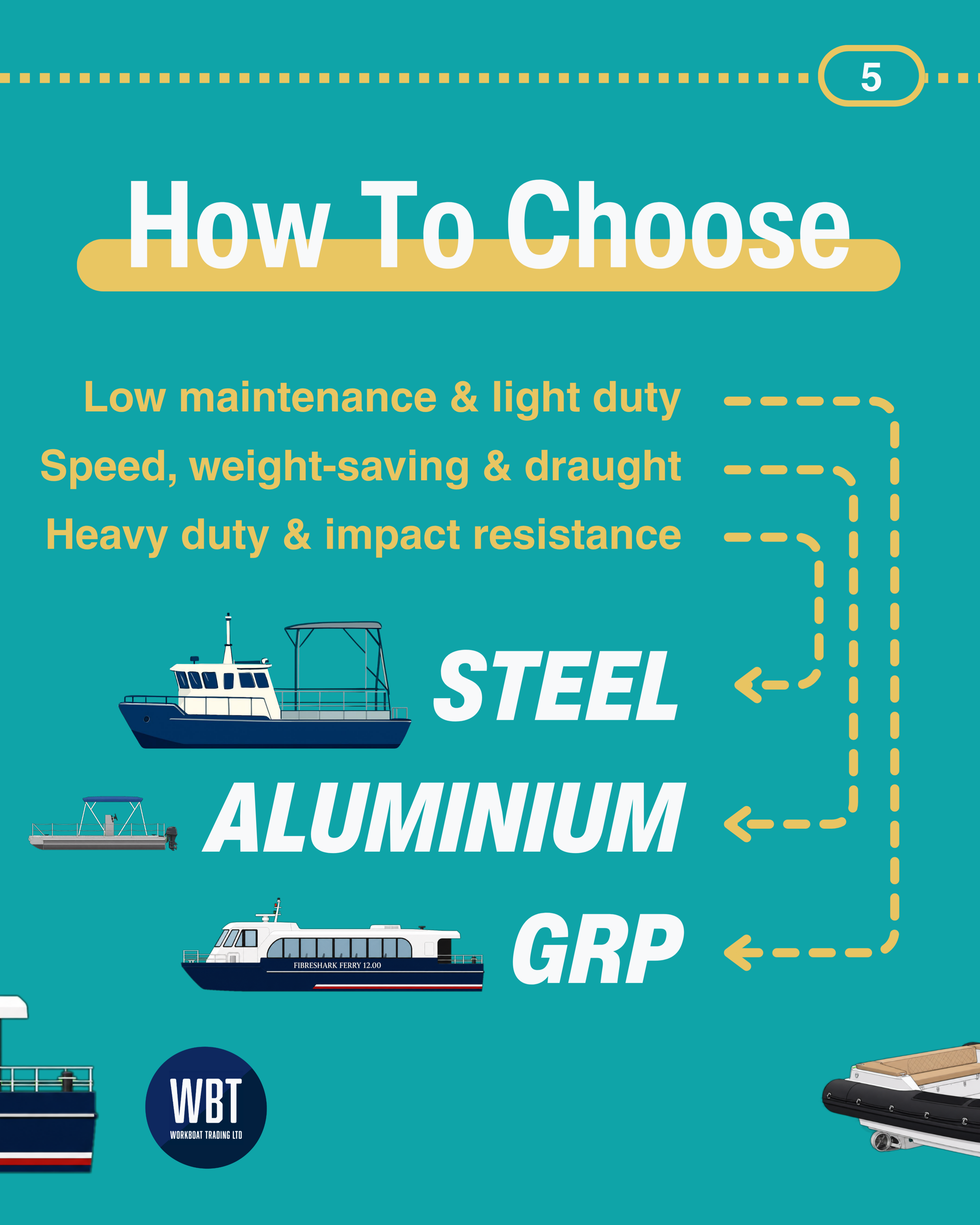
Heavy Commercial Operations
For tugs, anchor handlers, landing craft, cargo barges, and workboats requiring sustained bollard pull or heavy displacement operations, steel remains the strongest choice. The structural margin, fire resistance, and field repairability of steel construction align directly with the demands of heavy commercial duty cycles.
High-Speed and Lightweight Operations
For crew transfer vessels, fast patrol boats, pilot launches, and operations where speed, fuel efficiency, and shallow draught are priorities, aluminium provides the best balance of structural performance and weight savings. Operators must accept higher fabrication quality requirements and active fatigue management.
Light Harbour Utility and Series Production
For harbour launches, line boats, passenger tenders, fish-farm support vessels, and standardised utility craft below 24 metres, GRP offers the lowest recurring maintenance cost and excellent production economics for repeat builds. Operators must manage osmosis risk, accept fire performance limitations, and plan for the possibility that major structural damage may be uneconomical to repair.
Regulatory and Resale Considerations
In the Singapore market, hull material directly affects classification survey scope, insurance underwriting, and vessel resale value. Steel and aluminium vessels generally attract stronger residual values in the B2B marketplace due to their proven repairability and longer economic lives. GRP vessels may trade at a discount in the second-hand market, particularly if osmosis history or structural repair records are incomplete.
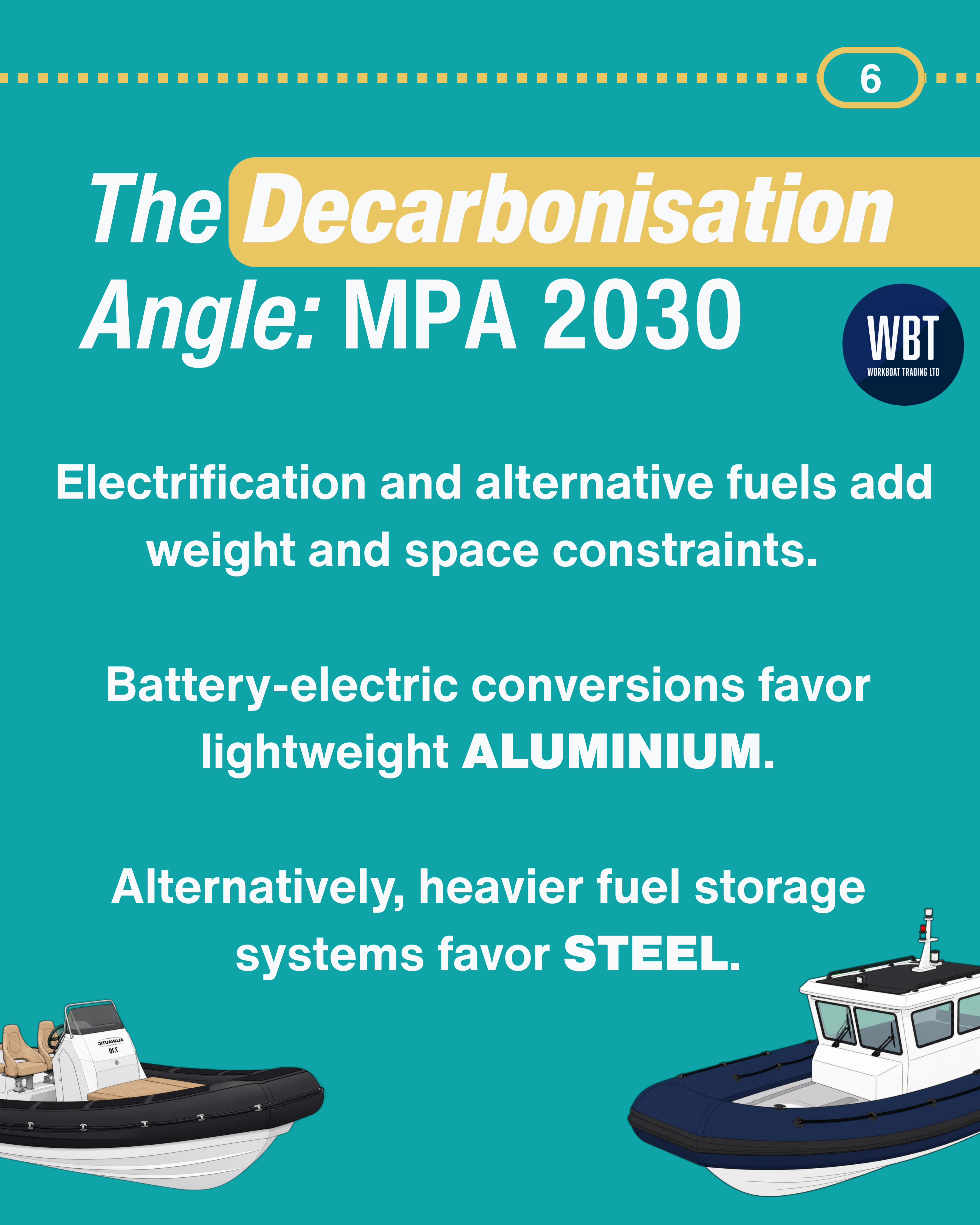
As the MPA 2030 harbour craft decarbonisation mandate reshapes fleet composition, hull material selection must also consider compatibility with battery-electric or alternative fuel propulsion systems. The weight and structural implications of battery installation, hydrogen storage, or methanol fuel systems will increasingly influence new hull material decisions.
FAQ
Which hull material is best for commercial workboats in Singapore?
The best hull material depends on the vessel's duty cycle, size, speed requirement, and maintenance model. Steel is generally preferred for heavy-duty displacement operations, aluminium for high-speed lightweight craft, and GRP for smaller harbour utility vessels with low maintenance budgets.
Does aluminium corrode in tropical seawater?
Aluminium forms a protective oxide layer and does not rust like steel. However, it is vulnerable to galvanic corrosion when in contact with dissimilar metals, and to crevice corrosion in areas where seawater is trapped. Proper bonding, insulation, and antifouling management are essential.
Is GRP suitable for heavy commercial workboats?
GRP is generally less suitable for heavy displacement, high-bollard-pull, or contact-intensive operations. Its combustibility, hidden damage susceptibility, and limited structural repairability make it better suited for lighter duty harbour craft and standardised utility vessels.
How does hull material affect workboat resale value in Southeast Asia?
Steel and aluminium vessels typically achieve stronger residual values due to longer economic lives and proven repairability. GRP vessels may trade at a discount, especially without documented osmosis treatment and structural inspection records. Browse available vessels on WBT Singapore to compare current market pricing across hull types.
What hull material is best for the MPA 2030 green mandate?
All three materials can accommodate compliant propulsion systems, but the structural weight of batteries, hydrogen tanks, or methanol fuel systems may favour aluminium for weight-sensitive electric conversions and steel for heavier alternative fuel installations. Read our full guide on navigating the MPA 2030 mandate for detailed compliance pathways.