Key Takeaways
- The CMA CGM Notre Dame represents a series of ten new LNG-powered containerships designed for the Asia-Europe trade corridor.
- The vessel integrates advanced artificial intelligence for route optimization and energy management to support Net Zero Carbon goals.
- The project reinforces France's strategic maritime presence by recruiting and training 135 French seafarers to operate the new fleet.
A Flagship for Energy Transition
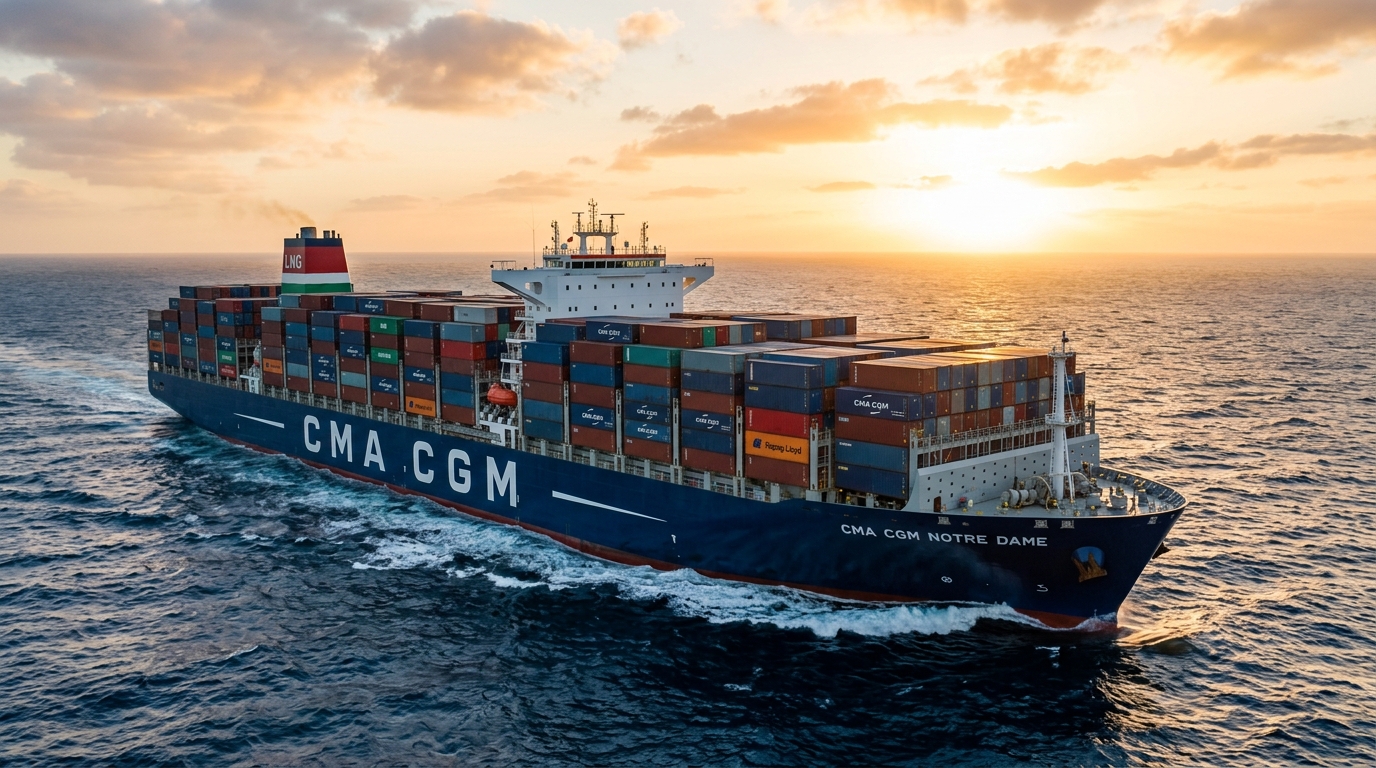
The maiden call of the CMA CGM Notre Dame in Singapore serves as a powerful statement for the future of large-scale container shipping. As the largest containership currently operating under the French flag, the vessel acts as the lead ship in a ten-unit series. This investment underscores the group's commitment to the energy transition, moving away from conventional bunker fuels toward liquefied natural gas (LNG) as a primary propulsion source. With a capacity of 24,212 TEU, the vessel demonstrates that extreme scale and environmental responsibility can be successfully integrated into the demanding Asia-Europe trade loop.
Engineering for Efficiency
Beyond its LNG propulsion system, the vessel is a showcase of modern naval architecture. Designed to minimize its carbon footprint, it features an innovative aerodynamic windshield system that reduces drag and fuel consumption. The onboard LNG tank, with a capacity of 18,600 cubic meters, provides the necessary autonomy for long-haul voyages between Asian hubs like Shanghai and Ningbo and European ports such as Le Havre and Hamburg. Furthermore, the inclusion of 1,600 reefer plugs equipped with smart energy-management systems ensures that the cold chain is maintained with maximum efficiency.
Digitalization and AI Integration
The bridge of the CMA CGM Notre Dame is a testament to the ongoing digital transformation of the maritime sector. By utilizing augmented reality and real-time trajectory prediction systems, the crew is empowered with superior situational awareness, particularly during complex maneuvering in congested ports. The integration of artificial intelligence for continuous route and speed adjustment marks a shift toward proactive, data-driven voyage management, supported by CMA CGM’s global fleet centers in Marseille, Miami, and Singapore.
Reclaiming French Maritime Heritage
This series of ten vessels, each named after iconic landmarks of French heritage, is registered under the French International Register (RIF). This strategic decision is as much about industrial policy as it is about shipping. By creating jobs for 135 highly trained French seafarers, the group is fostering a pipeline of maritime expertise that will be essential for managing the increasingly complex, tech-heavy vessels of the future. This initiative highlights the critical role of human capital in maintaining the operational continuity of global trade networks.
Singapore as a Strategic Decarbonization Hub
The choice of Singapore for this maiden call is not coincidental. As one of the world's leading bunkering and transshipment hubs, Singapore is pivotal to the deployment of dual-fuel fleets. CMA CGM’s deep collaboration with the Maritime and Port Authority of Singapore (MPA) and the presence of ZEBOX Asia Pacific underscore the region's importance in testing and scaling sustainable shipping solutions. The partnership serves as a blueprint for how global shipping lines must work in tandem with port states to facilitate the transition to alternative energy.
Looking Toward 2050
The CMA CGM Notre Dame and its sister ships are critical components of the company's ambition to achieve Net Zero Carbon by 2050. While LNG is often viewed as a transition fuel, the technical advancements displayed here, including optimized cargo carrying capacity and AI-driven efficiency, set a new standard for operational performance. As the industry grapples with the complexities of regulatory shifts and fuel uncertainty, this series provides a concrete example of how existing technologies can be leveraged to deliver immediate emissions reductions.